How to Remember Details About People
Why the details people share keep slipping, the attention habits that hold them in the moment, and the simple system that keeps them for years.

To remember details about people, do two things: hold the detail for three seconds when you hear it (say it back, ask one follow-up question), and write one line about it within a day. Attention gets the detail into your head. A note keeps it there for years. Neither works alone.
This guide covers both halves, plus which details are worth keeping for each person in your life.
Your coworker has mentioned his wife's name at least four times. Right now, mid-sentence, you need it, and it's gone. You steer the sentence somewhere else and feel the small, familiar shame of someone who was told and didn't keep it.
Here's what nobody says about that moment: you didn't forget the name. You never stored it. Those are different problems, and they have different fixes.
One scope note before we start. This guide is about the people already in your life: your partner, your parents, your coworkers, your friends. If your struggle is names and faces at events full of strangers, that's a different skill with its own playbook.
Why Do Details About People Slip Away?
Most "memory problems" with people are attention problems wearing a disguise.
When someone tells you their daughter switched schools, your brain has about three seconds to decide whether that information gets encoded or evaporates. If you're composing your reply, glancing at your phone, or half-listening while you cook, the decision gets made for you. The detail never lands. There is nothing to forget, because nothing was stored.
The second leak is slower. Details that do land fade anyway, because your brain keeps what it expects to reuse soon. A fact you won't need for six weeks ("her mom's surgery is in March") is exactly the kind of thing it quietly drops. Research on forgetting has shown the same curve for over a century: most of what we learn is gone within days unless something reinforces it.
So the fix has two halves. Catch the detail in the moment. Then give it somewhere to live.
How Do You Hold a Detail in the Moment?
Three habits, all invisible to the other person:
The three-second hold
When someone shares something that matters, give it three seconds of deliberate attention before you respond. Not performed attention. Actual attention: register what they said, notice why it matters to them. This sounds trivial. It is the single highest-leverage memory habit that exists, because encoding follows attention.
Say it back
Work the detail into your reply. "Wait, she switched schools? How's she taking it?" You just said it, heard it, and asked about it. Three repetitions inside ten seconds, and the conversation got warmer, not weirder. People love hearing their news taken seriously.
Hook it to something you know
New details stick to old ones. "His brother lives in Lisbon" attaches easily if you think "Lisbon, where Ana went last summer." The connection can be private and even silly. Silly hooks hold.
These habits will carry a detail for hours, sometimes days. They will not carry it through a busy quarter. For that, you need the second half.
How Do You Keep Details for Months and Years?
Write one line, within a day, somewhere attached to the person.
That's the entire system. After a call with your dad: "Knee is better, started woodworking again." After coffee with a friend: "Interview at the hospital on the 22nd, nervous." Ten seconds of typing, and the detail stops depending on your brain.
Where you keep the lines matters less than keeping them in one place, organized by person rather than by date. A notes app with one note per person works. The notes field in your contacts works. A private relationship app like Kinu is built for exactly this, with the details, dates, and moments attached to each person and brought back when they matter.
We cover the full capture system, the weekly review habit, and an honest comparison of the tools in how to remember important things about your friends. The short version: pick the place you'll actually open, and let the habit be small.
Which Details Matter for Which People?
Not every relationship needs the same memory. The details that make someone feel seen depend on who they are to you:
Your partner
The small logistics of their inner life: the meeting they're dreading, the friend who hurt them, what they said they wanted months ago. Partners forgive forgotten errands. Forgotten feelings cost more.
Your parents
Their health appointments, their projects, the neighbors and friends they mention. Asking your mom about the garden club feud by name does more than an hour of generic catching up.
Coworkers
The life outside work they choose to share: the kid's team, the house hunt, the marathon. One remembered detail turns a colleague into a person. Just keep it to what they offered freely.
Friends
Whatever they're carrying right now: the job search, the new relationship, the thing they're worried about. The follow-up question two weeks later is the friendship.
Across all of them, the same filter applies: would this person feel cared about if you brought it up next time? If yes, it's worth three seconds and one line. If not, let it go. You are not building an archive. You are catching what matters.
And dates are their own category. Birthdays and anniversaries don't need memory at all, just a reminder system you set up once.
What If You Blank Mid-Conversation?
It will happen. The name vanishes exactly when you need it. The honest move beats every workaround:
I'm blanking on your wife's name and I hate it, because I remember everything you've told me about her. Help me out?
That lands fine, every time, because it makes the important thing clear: the person mattered, the label slipped. What reads badly is the dance of avoidance, the "hey... you!" and the careful sentence engineering. People can feel that from across the room.
Then write the name down, attached to the person, so the blank never repeats. The recovery is graceful once. The note makes sure you only need it once.
The Quiet Compounding
Here is what changes after a few months of three-second holds and one-line notes.
Conversations start where they left off instead of starting over. "How's your mom doing after the surgery?" instead of "what's new?" People begin to describe you with words like thoughtful, and what they mean is: you make them feel like their life registered with someone.
It was never about memory capacity. The people who remember everything just decided the details were worth catching. Now you have the how.
If you want one calm, private place for those one-line notes, where every detail stays attached to the person it belongs to, that's what Kinu was built for. Your data stays on your device unless you opt into encrypted sync. Free for your first 10 people on iOS and Android.
Frequently Asked Questions
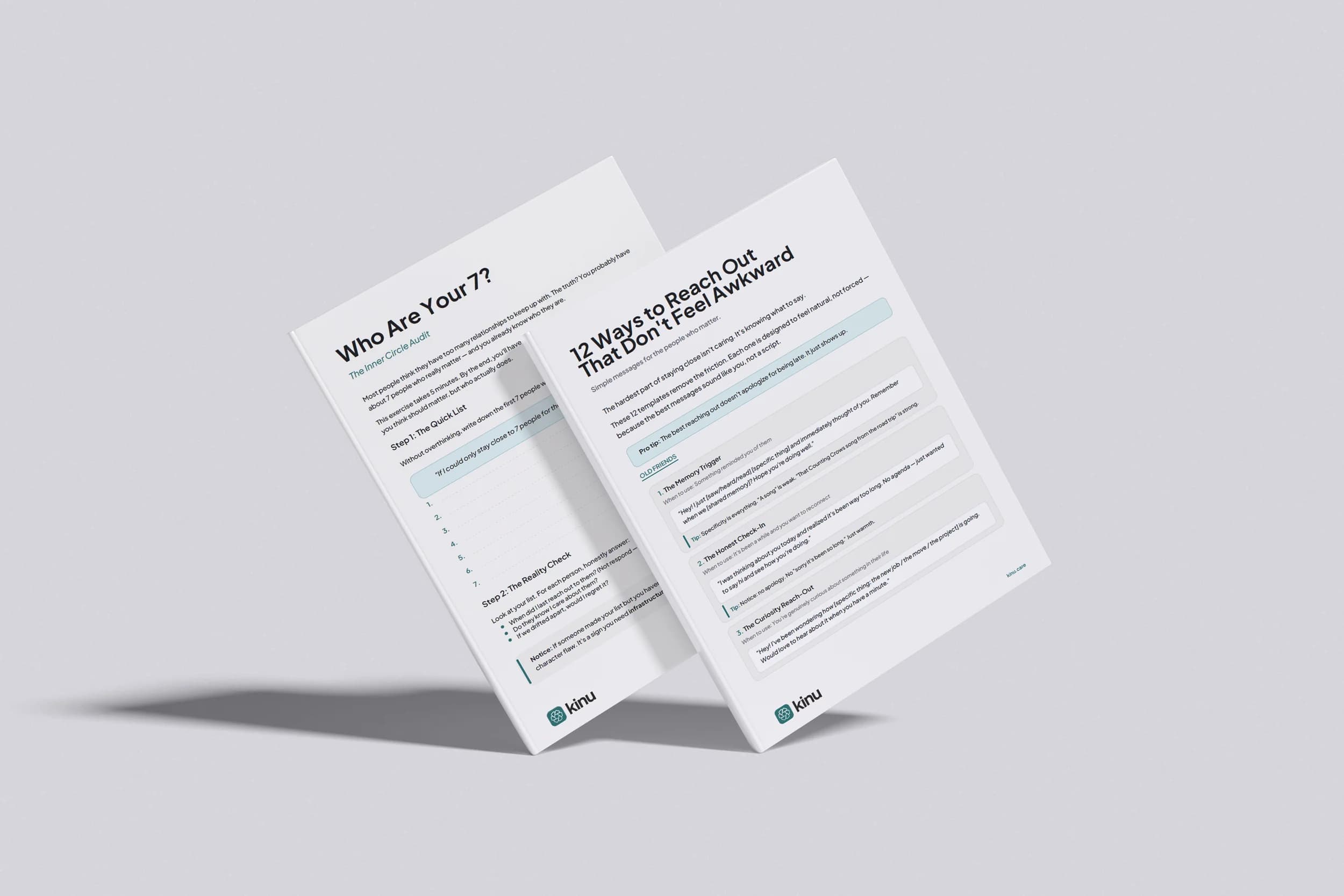
Free Reconnection Kit
Find your inner circle in five minutes.
A 5-minute exercise to find your inner circle and 12 reach-out templates that sound like you. Free, instant download.
Instant download. No spam. Unsubscribe anytime.
Keep reading

How to Remember Names and Details About People You Just Met
Names vanish during the handshake because they were never stored. The five-second fix, the recovery scripts, and the note that turns a stranger into a person.

How to Keep Track of Gift Ideas All Year
The best gift ideas arrive in March and die by April. How to catch them when people drop hints, organize them by person, and walk into December stocked.
How to Remember Important Things About Your Friends
Practical systems for remembering the little things your friends share, why your brain forgets them, and the best apps for keeping those details safe.