La recesión de la amistad: lo que dicen realmente las estadísticas
Los estadounidenses tienen menos amigos cercanos que nunca. Estos son los grandes estudios sobre la recesión de la amistad, desde las advertencias del Cirujano General hasta los datos globales.
El porcentaje de estadounidenses que dice no tener amigos cercanos, según la encuesta que se consulte. En 1990 esa cifra era del 3%: se ha multiplicado por entre cuatro y seis en una sola generación.
Survey Center on American Life (2021) / Pew Research (2025)
¿Qué es la recesión de la amistad?
La recesión de la amistad es el declive documentado de las amistades cercanas en todo el mundo desarrollado. El término es literal: un descenso medible, seguido a lo largo de décadas de encuestas, confirmado por instituciones de investigación independientes y lo bastante grave como para que el Cirujano General de EE. UU. lo haya declarado una crisis de salud pública.
Este artículo reúne las estadísticas más importantes sobre la recesión de la amistad a partir de los grandes estudios. Cada cifra procede de un estudio concreto, y las fuentes clave están enlazadas al final. Si escribes sobre este tema, lo estás investigando o simplemente intentas entender qué le está pasando a la conexión social en el mundo moderno, estos son los datos.
Las estadísticas clave de un vistazo
Estadounidenses que consideran que los amigos cercanos son extremadamente o muy importantes para una vida plena. Eso coloca a la amistad por delante de tener hijos (26%), tener mucho dinero (24%) y estar casado (23%).
Pew Research Center, 2023
Hombres estadounidenses que declaran no tener ningún amigo cercano, entre 1990 y 2021: cinco veces más. Para 2021, el 10% de las mujeres decía no tener amigos cercanos.
Survey Center on American Life, 2021
La comparación del Cirujano General de EE. UU. para el impacto del aislamiento social y la soledad en la salud. La soledad se asocia con un riesgo de mortalidad prematura un 26% mayor.
U.S. Surgeon General Advisory, 2023
El descenso del número promedio de amigos cercanos de los estadounidenses en las últimas dos décadas.
American Perspectives Survey
Los datos: cómo están disminuyendo las amistades
El colapso de la amistad en Estados Unidos
Los datos más completos sobre la recesión de la amistad provienen del Survey Center on American Life, que lleva décadas siguiendo las conexiones sociales a través de la American Perspectives Survey.
En 1990, el 3% de los estadounidenses decía no tener amigos cercanos. Para 2021, esa cifra había subido al 12%. Quienes tenían 10 o más amigos cercanos pasaron del 33% al 13%. En el mismo periodo, la proporción que declara 3 amigos cercanos o menos casi se duplicó: del 27% en 1990 al 49% en 2021.
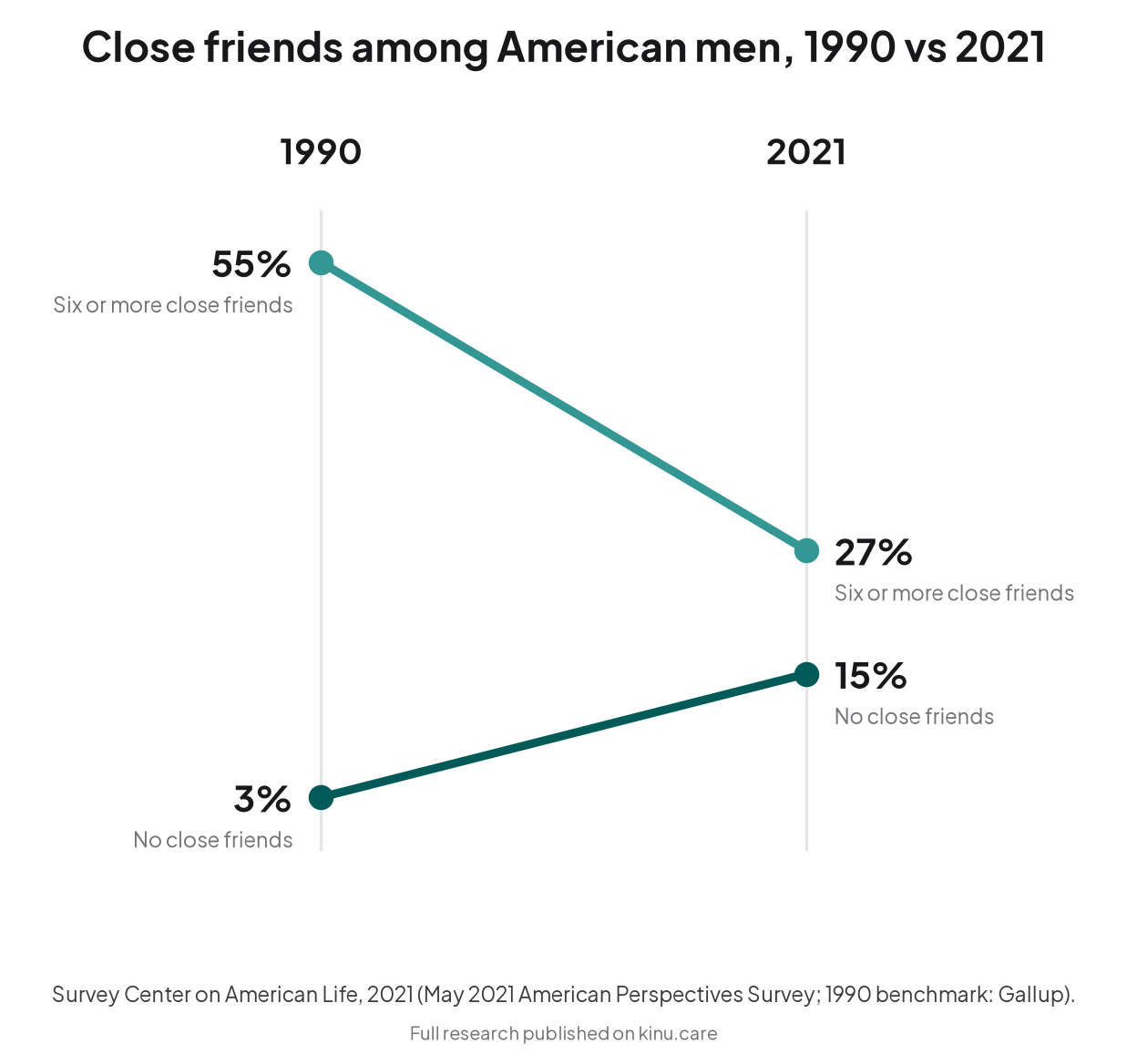
El declive es más marcado entre los hombres. El porcentaje de hombres sin ningún amigo cercano pasó del 3% al 15% entre 1990 y 2021, cinco veces más. Para 2021, el 10% de las mujeres decía lo mismo, aunque no se publicó una cifra de 1990 separada para ellas. Los hombres con al menos 6 amigos cercanos cayeron del 55% al 27%.
¡
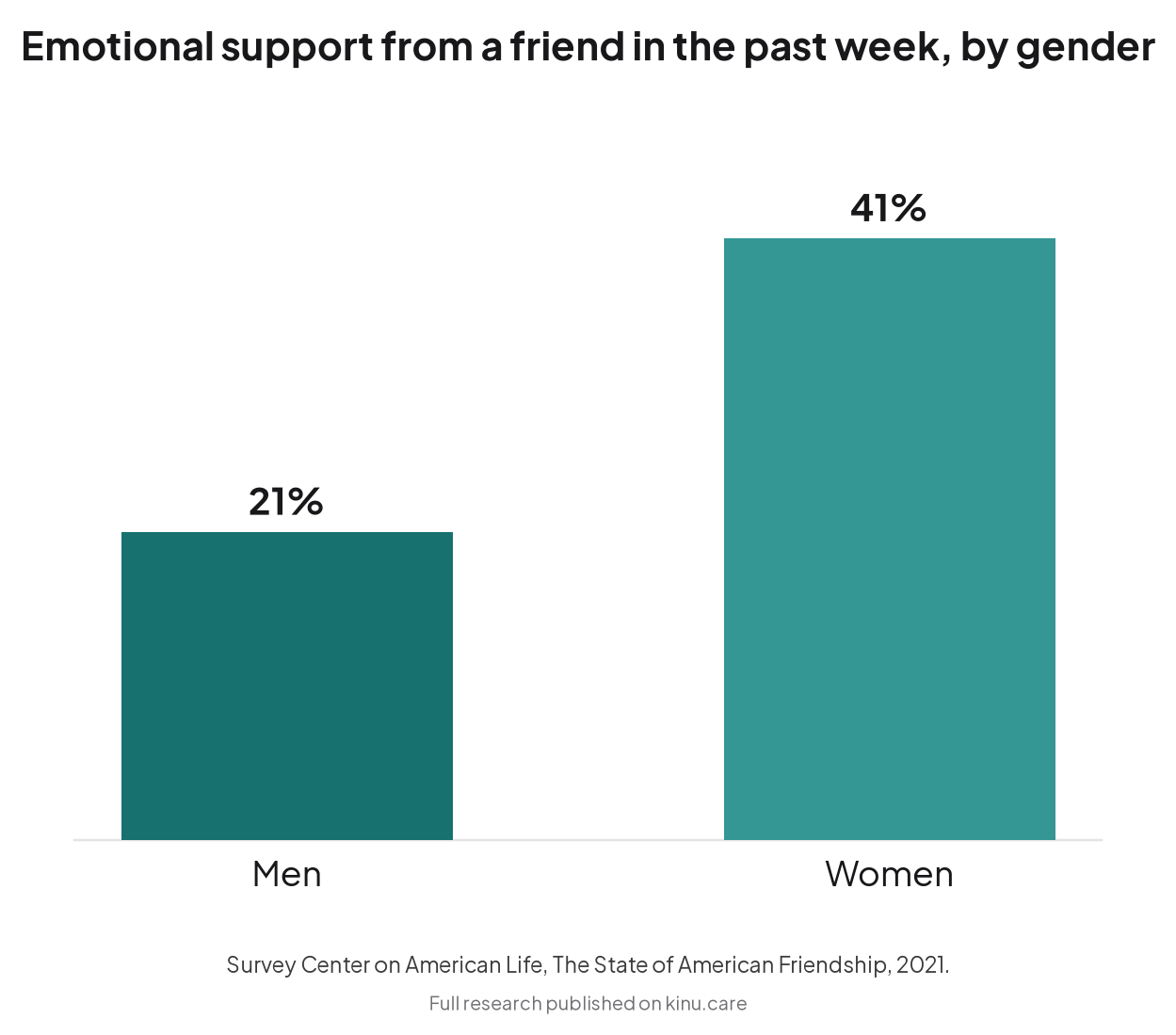
La brecha no es solo de números. En la misma encuesta, el 41% de las mujeres afirmó haber recibido apoyo emocional de una amistad en la última semana, frente al 21% de los hombres, aproximadamente la mitad.
¡
La encuesta de seguimiento del propio Survey Center apunta en la misma dirección. En su American Social Capital Survey de 2024, realizada en la primavera de ese año, el 17% de los estadounidenses declaró no tener amigos cercanos, una categoría que excluye a los familiares cercanos, y la cifra sube al 24% entre los adultos con educación secundaria o menos.
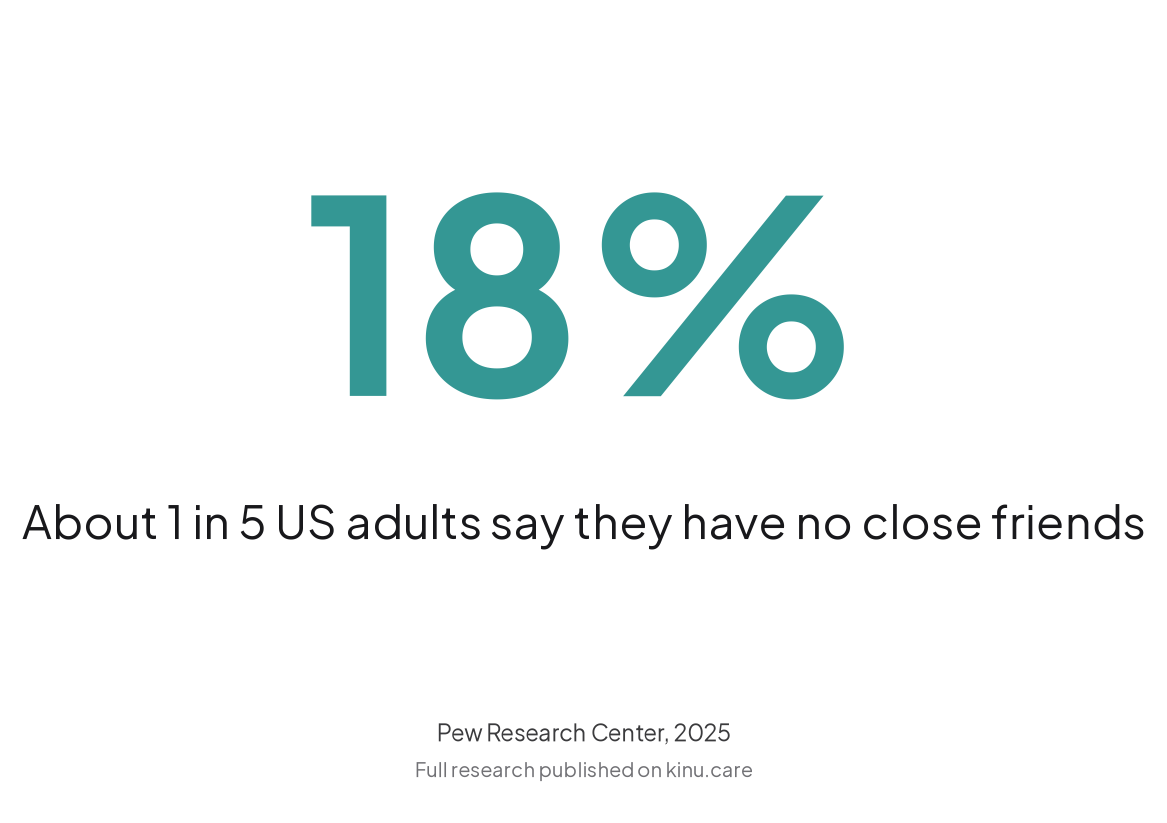
Para 2025, el Pew Research Center encontró una cifra aún más alta: el 18% de los adultos estadounidenses dice no tener amigos cercanos fuera de su familia.
Una encuesta a 6204 adultos de EE. UU. encontró que el 18% dice no tener amigos cercanos fuera de la familia. El 16% se siente solo 'todo o la mayor parte del tiempo'. Entre los adultos menores de 30 años, casi el 25% se siente solo todo o la mayor parte del tiempo. Las mujeres recurren más a sus amistades en busca de apoyo emocional (54%) que los hombres (38%).
¡
El tiempo presencial con amigos cayó de un promedio de 60 minutos al día en 2003 a 34 minutos en 2019, y a 20 minutos en 2020. La mayor parte de ese descenso ocurrió antes de la pandemia. En el mismo periodo, el tiempo a solas subió de 285 minutos diarios a 333. Entre los jóvenes de 15 a 24 años, el tiempo presencial con amigos se redujo alrededor de un 70%, de unos 150 minutos al día a 40.
La advertencia del Cirujano General
En 2023, el Cirujano General de EE. UU., el Dr. Vivek Murthy, emitió un aviso formal sobre la epidemia de soledad y aislamiento, y lo calificó como uno de los mayores desafíos de salud pública de nuestro tiempo.
La soledad se asocia con un riesgo de muerte prematura un 26% mayor, y el aislamiento social con un 29% mayor. La falta de conexión social se asocia con un 29% más de riesgo de enfermedad cardíaca y un 32% más de riesgo de accidente cerebrovascular, y la soledad con cerca de un 50% más de riesgo de demencia en adultos mayores. Desde 2003, el tiempo a solas ha aumentado unas 24 horas al mes, mientras que el tiempo presencial con amigos ha caído unas 20 horas al mes.
No fue un comentario de pasada. Fue un aviso de 82 páginas, el mismo formato que se usó para el tabaco y los opioides. El Cirujano General situó la desconexión social junto al abuso de sustancias y la violencia entre las amenazas para la salud de los estadounidenses. Los jóvenes de 15 a 24 años tenían un 70% menos de interacción social con amigos que dos décadas antes.
"Given the significant health consequences of loneliness and isolation, we must prioritize building social connection the same way we have prioritized other critical public health issues such as tobacco, obesity, and substance use disorders."
Traducción: "Dadas las graves consecuencias para la salud de la soledad y el aislamiento, debemos dar prioridad a construir conexión social del mismo modo en que hemos dado prioridad a otros problemas críticos de salud pública como el tabaco, la obesidad y los trastornos por consumo de sustancias."
U.S. Surgeon General, 2023
Otras fuentes que lo confirman: Gallup y Cigna
Los datos de la recesión de la amistad no dependen de una sola encuesta. Varias instituciones de investigación han documentado tendencias que se solapan entre sí.
Una encuesta a más de 7500 adultos de EE. UU. encontró que el 57% de los estadounidenses se siente solo. La Generación Z declara la soledad más alta, un 67%, seguida de los millennials con un 65%. Los baby boomers registran la más baja, un 44%. El 52% de los trabajadores se siente solo en el trabajo. La soledad cuesta a los empleadores unos 154 mil millones de dólares al año en ausentismo.
Solo el 44% de los estadounidenses se declara 'muy satisfecho' con su vida personal, el nivel más bajo de la serie de Gallup desde 2001. El máximo fue un 65% en enero de 2020, justo antes de la pandemia.
Perspectiva internacional: no es solo un problema estadounidense
Es un fenómeno global. Los datos más abundantes son los de Estados Unidos, pero tendencias similares aparecen en todo el mundo desarrollado.
| País/Región | Hallazgo clave | Fuente |
|---|---|---|
| Reino Unido | El 25% de los adultos se siente solo al menos parte del tiempo. Los jóvenes de 16 a 24 años tienen el doble de probabilidades (29%) de sentirse solos que las personas de 65 a 74 (15%). En 2018 se nombró un Ministro de la Soledad. | UK Office for National Statistics, 2025 |
| Unión Europea | El 8% de los encuestados en 22 países de la UE no tiene amigos cercanos. Francia (11%) y Lituania (9%) registran las tasas más altas de soledad 'la mayor parte o todo el tiempo'. Seis países de la UE han puesto en marcha estrategias nacionales contra la soledad. | EU Joint Research Centre, 2022 |
| Australia | El 54% de los australianos afirma que su círculo de amistades se está reduciendo. El 32% se siente socialmente aislado. Entre la Generación Z, la cifra sube al 58%. La soledad le cuesta a Australia unos 2700 millones de dólares australianos al año en gastos de salud. | Real Relationships Report, 2025 |
| Japón | Más de 1.5 millones de personas clasificadas como hikikomori (aislamiento social extremo). Más de 600 000 tienen entre 40 y 64 años. Japón nombró un ministro encargado del aislamiento social en 2021 y aprobó una ley sobre la soledad en abril de 2024. | Japanese Cabinet Office |
El patrón se repite en Europa en su conjunto. En su informe de 2025 sobre conexiones sociales, la OCDE midió con qué frecuencia las personas de 21 países europeos de la OCDE ven a sus amigos en persona a diario, y encontró las caídas más pronunciadas entre los jóvenes. Entre 2015 y 2022, el contacto presencial diario con amigos bajó del 46% al 37% entre los hombres jóvenes y del 41% al 34% entre las mujeres jóvenes, los mayores descensos de cualquier grupo de edad. Los jóvenes, las personas con ingresos bajos, los desempleados y las personas solteras fueron quienes más contacto perdieron, y los jóvenes fueron además el único grupo de edad que no aumentó de manera significativa el contacto a distancia para compensarlo.
El nombramiento de un Ministro de la Soledad en el Reino Unido en 2018 puso la desconexión social, por primera vez, en la agenda de un gabinete nacional.
Cómo se siente la recesión de la amistad
Los números describen la forma del fenómeno. Vivirlo por dentro se siente distinto.
Rara vez se percibe como una crisis. Se parece más a una etapa de mucho ajetreo que no se acaba nunca: planes que se aplazan, meses que pasan, la intención intacta y el calendario siempre lleno.
En algún momento las cuentas salen a la superficie: no recuerdas la última conversación de verdad con alguien que no sea tu pareja o un colega del trabajo. Tienes cientos de contactos en línea y nadie a quien llamar cuando llega una mala noticia. Tienes conocidos de sobra y pocas personas con las que te sientes cercano de verdad.
La soledad rara vez se anuncia. Se acumula: un café que no se concretó, un mensaje sin responder, un "a ver si nos vemos pronto" que nunca se convierte en plan. Ninguno importa por sí solo. Con los años, la suma adelgaza una vida social.
Esa erosión gradual es lo que distingue este problema de otros problemas de salud pública. No hay un evento único que señalar, solo un desvanecimiento lento de "tengo gente" a "estoy solo" que puede tardar años en notarse.
¿Por qué está ocurriendo?
No la causa un único factor. Convergen varias fuerzas estructurales.
El colapso de los terceros lugares
El sociólogo Ray Oldenburg acuñó el término "terceros lugares" para los espacios entre el hogar y el trabajo donde la comunidad se forma de manera orgánica. Cafés, barberías, iglesias, centros comunitarios, ligas deportivas. Estos espacios llevan décadas en fuerte declive. Robert Putnam lo documentó en Bowling Alone (2000), y la tendencia no ha hecho más que acelerarse desde entonces. Sin espacios físicos compartidos, formar nuevas amistades exige un esfuerzo deliberado que antes ocurría de forma automática.
Trabajo remoto e híbrido
El paso al trabajo remoto ha sido bueno para la flexibilidad y para reducir los traslados. Para las amistades del trabajo ha sido devastador. La oficina era uno de los últimos "terceros lugares" que les quedaban a muchos adultos. Las conversaciones junto a la máquina de café, los almuerzos en grupo y las salidas al terminar la jornada aportaban contacto social orgánico. El trabajo remoto eliminó todo eso.
Sustitución por redes sociales
Dos grandes estudios de 2025, de Oregon State y de Baylor, vincularon el uso intensivo de redes sociales con más soledad; la sección de investigación más abajo recoge sus cifras, y en redes sociales y soledad está nuestro análisis más extenso. El tiempo de scroll reemplaza al tiempo de interacción directa y recíproca. Te sientes conectado, pero en realidad estás mirando la vida de otros desde fuera. La ilusión de conexión es posiblemente peor que la ausencia total de conexión.
Movilidad geográfica
Los estadounidenses se mudan con más frecuencia que la gente de la mayoría de los países. Cada mudanza corta las redes de amistad locales. Antes de internet, mudarse significaba perder el contacto con casi todo el mundo. Hoy significa mantener la ilusión de conexión a través de las redes sociales mientras se pierde la proximidad que hace que las amistades funcionen.
La trampa de estar siempre ocupado
Los estadounidenses trabajan más horas que los trabajadores de la mayoría de los países desarrollados. Al combinar jornadas largas con traslados, tareas del hogar y crianza, el tiempo social queda reducido a lo que sobra, que muchas veces no es nada. La amistad se convierte en algo que pasará "cuando las cosas se calmen". Las cosas nunca se calman.
Transiciones de vida sin reemplazo
La universidad es una fábrica de amistades incorporada: espacio compartido, horarios compartidos, experiencias compartidas y tiempo libre en abundancia. Después de graduarse, ninguna de esas condiciones existe. Cada transición vital (trabajo nuevo, ciudad nueva, matrimonio, hijos) estrecha un poco más el círculo social. El desvanecimiento natural de las amistades se acelera sin ninguna fuerza que lo contrarreste. Y para quienes sí quieren reconstruir, hacer amigos de adulto exige una planificación que la universidad hacía innecesaria.
Lo que le hace a tu salud
Los datos de salud son tan crudos como el panorama emocional.
Mayor riesgo de muerte prematura asociado a la soledad, según los metaanálisis citados por el Cirujano General. El aislamiento social conlleva un riesgo un 29% mayor.
Holt-Lunstad et al., metaanálisis
El estudio más largo jamás realizado sobre la vida adulta encontró que la calidad de tus relaciones a los 50 años predice mejor tu salud a los 80 que tus niveles de colesterol. Las relaciones cercanas, más que el dinero o la fama, son lo que mantiene a las personas felices y sanas a lo largo de la vida.
Los riesgos específicos para la salud asociados al aislamiento social incluyen:
Cardiovascular
El aislamiento social se asocia con un riesgo un 29% mayor de enfermedad cardíaca y un 32% mayor de accidente cerebrovascular, cifras comparables a las de factores de riesgo establecidos como la inactividad física y la obesidad.
Deterioro cognitivo
La soledad se asocia con un riesgo de demencia un 50% mayor. El mecanismo propuesto pasa por el estrés crónico, que puede afectar la salud cerebral con el tiempo.
Salud mental
El aislamiento social se asocia con un riesgo de depresión un 50% mayor y con aumentos similares de la ansiedad. La soledad se ha vinculado a las mismas regiones cerebrales implicadas en el dolor físico.
Función inmunitaria
La soledad crónica se asocia con marcadores de inflamación elevados y una respuesta inmunitaria debilitada, y se ha vinculado a una mayor propensión a enfermar.
El costo económico
Las consecuencias económicas también se pueden medir.
La soledad le cuesta al Medicare de EE. UU. unos 6700 millones de dólares al año. Alrededor del 14% de los afiliados a Medicare (unos 4 millones de personas) tiene conexiones sociales inadecuadas. Las personas aisladas le cuestan a Medicare 137 USD adicionales al mes (unos 1644 USD al año) por persona.
La soledad les cuesta a los empleadores unos 154 mil millones de dólares al año en ausentismo relacionado con el estrés. Los empleados que se sienten solos faltan unos 5 días más al año que sus compañeros que no se sienten así. Además, tienen casi el doble de probabilidades de plantearse renunciar.
La soledad sale cara en el sentido más literal y contable del término, y la mayoría de las organizaciones nunca la ha puesto en números.
La paradoja de las redes sociales
En puro alcance, esta es la generación más contactable que ha existido jamás. Aun así, las cifras de soledad subieron. La investigación explica por qué.
Un estudio con más de 1500 adultos estadounidenses de 30 a 70 años encontró que quienes estaban en el 25% superior de frecuencia de uso de redes sociales tenían más del doble de probabilidades de experimentar soledad. Tanto el tiempo como la frecuencia de uso se asociaron con la soledad de forma independiente y lineal (p < 0.001). Muchas consultas breves resultaban tan dañinas como pocas sesiones largas.
Un estudio longitudinal que siguió a casi 7000 adultos neerlandeses durante nueve años (2014-2022) encontró que tanto el uso pasivo (hacer scroll sin interactuar) como el activo (publicar, participar) se vinculaban con un aumento de la soledad con el tiempo. Existe un circuito de retroalimentación bidireccional: las personas que se sienten solas recurren a las redes sociales, y estas intensifican su soledad en lugar de aliviarla.
Un estudio con 373 adultos jóvenes (de 18 a 24 años) encontró que una semana de desconexión total de las redes sociales redujo los síntomas de depresión un 24.8%, los de ansiedad un 16.1% y los de insomnio un 14.5%. Los beneficios fueron mayores en quienes tenían síntomas más severos al inicio. Llama la atención que la desconexión no redujo de forma significativa la soledad en sí.
Un estudio con 1632 adultos jóvenes del Reino Unido encontró que no todas las plataformas afectan la soledad por igual. WhatsApp se asoció con menos soledad. Reddit y las aplicaciones de citas se asociaron con más. Facebook, Instagram y Twitter no mostraron una asociación significativa en ningún sentido. La variable clave: si la plataforma facilita la comunicación directa uno a uno.
Las plataformas que facilitan la comunicación directa y recíproca pueden sostener una conexión real; las construidas alrededor del consumo pasivo de contenido curado la socavan. La mayoría de la gente pasa mucho más tiempo en las segundas.
La Generación Z: la más conectada y la más sola
El porcentaje de la Generación Z (18 a 27 años) que se clasifica como personas que se sienten solas, el más alto de todas las generaciones. Casi el 25% de los estadounidenses menores de 30 se siente solo 'todo o la mayor parte del tiempo'. El 63% de los adultos jóvenes que se sienten solos declara además niveles importantes de ansiedad o depresión.
Cigna 2025 / Pew Research 2025
La soledad es más aguda entre los jóvenes, no entre los mayores. La Generación Z llegó a la adultez en un entorno donde las redes sociales reemplazaron muchos de los rituales presenciales con los que las generaciones anteriores construían amistades. El resultado: una generación con miles de conexiones en línea y una sensación generalizada de aislamiento.
Lo que nos dicen los números de Dunbar
La investigación de Robin Dunbar sobre las capas de las redes sociales ofrece un marco para entender por qué la recesión de la amistad golpea tan fuerte.
5: Tu círculo íntimo
Las relaciones más cercanas. Son las personas a las que llamarías en una crisis. Mantener cinco relaciones profundas exige una inversión emocional considerable. La mayoría de las personas está por debajo de este número.
15: Tu grupo de afinidad
Buenos amigos que te importan de verdad y con quienes mantienes contacto regular. Es la capa que más se ha adelgazado.
50: Tu red cercana
Personas a las que invitarías a una cena de grupo. Conoces sus vidas lo suficiente para tener una conversación real. Esta capa se erosiona a medida que declinan las estructuras comunitarias.
150: El número de Dunbar
El número máximo de relaciones sociales estables que el cerebro humano puede mantener. Más allá, las personas se vuelven desconocidas. Las redes sociales solo crean la ilusión de superarlo.
Las pérdidas se concentran en las capas internas, el 5 y el 15, justo donde viven los efectos sobre la salud; por eso menos amistades, pero más profundas ganan a los círculos amplios. Mil conocidos no pueden reemplazar a un amigo cercano.
Qué ayuda de verdad
La tendencia es estructural y el esfuerzo individual por sí solo no va a revertirla. Pero la investigación señala enfoques concretos que protegen y fortalecen tus conexiones sociales personales.
Nombra tu círculo íntimo
Las amistades que sobreviven a la adultez son, de forma abrumadora, las que la gente eligió a propósito; la inercia se lleva el resto (por qué se desvanecen las amistades explica la mecánica). Empieza por nombrar a las 5-15 personas que más te importan y anótalas. Si no puedes nombrarlas, esa es la primera señal sobre la que vale la pena actuar.
Crea rituales recurrentes, no propósitos
Las amistades que sobreviven casi siempre comparten una cosa: un ancla recurrente. Una cena mensual. Un grupo de caminata semanal. Un viaje trimestral. Los rituales eliminan la fricción de planificar y la sustituyen por inercia. "¿Nos vemos un día de estos?" fracasa. "¿Mismo día el mes que viene?" funciona.
Baja la exigencia del contacto
El gran asesino de las amistades adultas no es el conflicto: es el silencio. Y el silencio crece porque fijamos un estándar irrealmente alto para lo que significa "mantenerse en contacto".
Oye, vi esto y me acordé de ti. Espero que estés bien.
Una nota de voz rápida, un artículo compartido, una foto que te hizo pensar en alguien. Todo eso cuenta. Mantiene vivo el hilo entre las interacciones más grandes. Para el mantenimiento, la frecuencia importa más que la profundidad.
Construye infraestructura, no fuerza de voluntad
Las personas que mantienen amistades sólidas a lo largo de años como estos suelen tener sistemas externos. Puede ser un calendario con recordatorios recurrentes, un lugar donde recordar las pequeñas cosas de tus amigos o una herramienta dedicada. El sistema compensa lo que la vida moderna ya no proporciona por sí sola.
La fuerza de voluntad se agota. Un sistema sigue funcionando los días en que estás cansado, y esa es justamente la razón de tenerlo.
Únete a un tercer lugar o crea uno
Clubes de lectura, grupos de corredores, organizaciones de voluntariado, espacios de coworking, comunidades religiosas, grupos de pasatiempos. La actividad concreta importa menos que el contacto regular y presencial con las mismas personas a lo largo del tiempo. La proximidad y la repetición son la materia prima de la amistad, y ninguna tecnología puede sustituirlas.
Prioriza la profundidad sobre la amplitud
En una era de redes sociales y cultura del networking, hay presión por mantener tantas conexiones como sea posible. Resístete. Cinco amistades profundas valen más para tu salud y tu felicidad que 500 superficiales. Concentra tu energía social, que es limitada, donde de verdad importa.
La oportunidad dentro de la recesión
Hay un matiz genuinamente esperanzador: como tanta gente está en el mismo pozo al mismo tiempo, la barrera para reconectar es más baja de lo que parece.
¿Ese amigo con quien no hablas desde hace meses? Probablemente siente la misma culpa. ¿Ese conocido al que te gustaría conocer mejor? Probablemente anhela el mismo tipo de conexión genuina.
La gente sobreestima sistemáticamente lo incómodo que será reconectar; los estudios que lo demuestran, y qué escribir exactamente, están en nuestra guía para reconectar. Casi nadie da el primer paso, así que quien lo da destaca.
Escribir, aunque sean dos líneas, ya es suficiente.
Nadie puede revertir por su cuenta el declive de los terceros lugares ni reestructurar la semana laboral. Un sistema personal para mantenerte cerca de tu gente es la pieza que sí está a tu alcance.
Kinu se creó exactamente para esto: un lugar privado para tu círculo íntimo, las pequeñas cosas que quieres recordar de cada persona y un recordatorio amable cuando ha pasado un tiempo. Un CRM personal para tu vida personal, y nada más.
Fuentes
- Survey Center on American Life, The State of American Friendship (2021) y Why Men's Social Circles Are Shrinking (2021)
- Survey Center on American Life, Disconnected: The Growing Class Divide in American Civic Life (2024)
- Pew Research Center, Men, Women and Social Connections (2025) y What makes for a fulfilling life (2023)
- OCDE, Social Connections and Loneliness in OECD Countries (2025)
- U.S. Surgeon General, Our Epidemic of Loneliness and Isolation (2023)
- Holt-Lunstad et al., Social Relationships and Mortality Risk: A Meta-analytic Review, PLOS Medicine (2010)
- Harvard Study of Adult Development
- Kannan y Veazie, US trends in social isolation, social engagement, and companionship, 2003 a 2020, SSM-Population Health (2023)
- UK Office for National Statistics, Community Life Survey: loneliness (2025)
- Robin Dunbar, por qué el límite de 150 amistades sigue en pie (2021)
Preguntas frecuentes
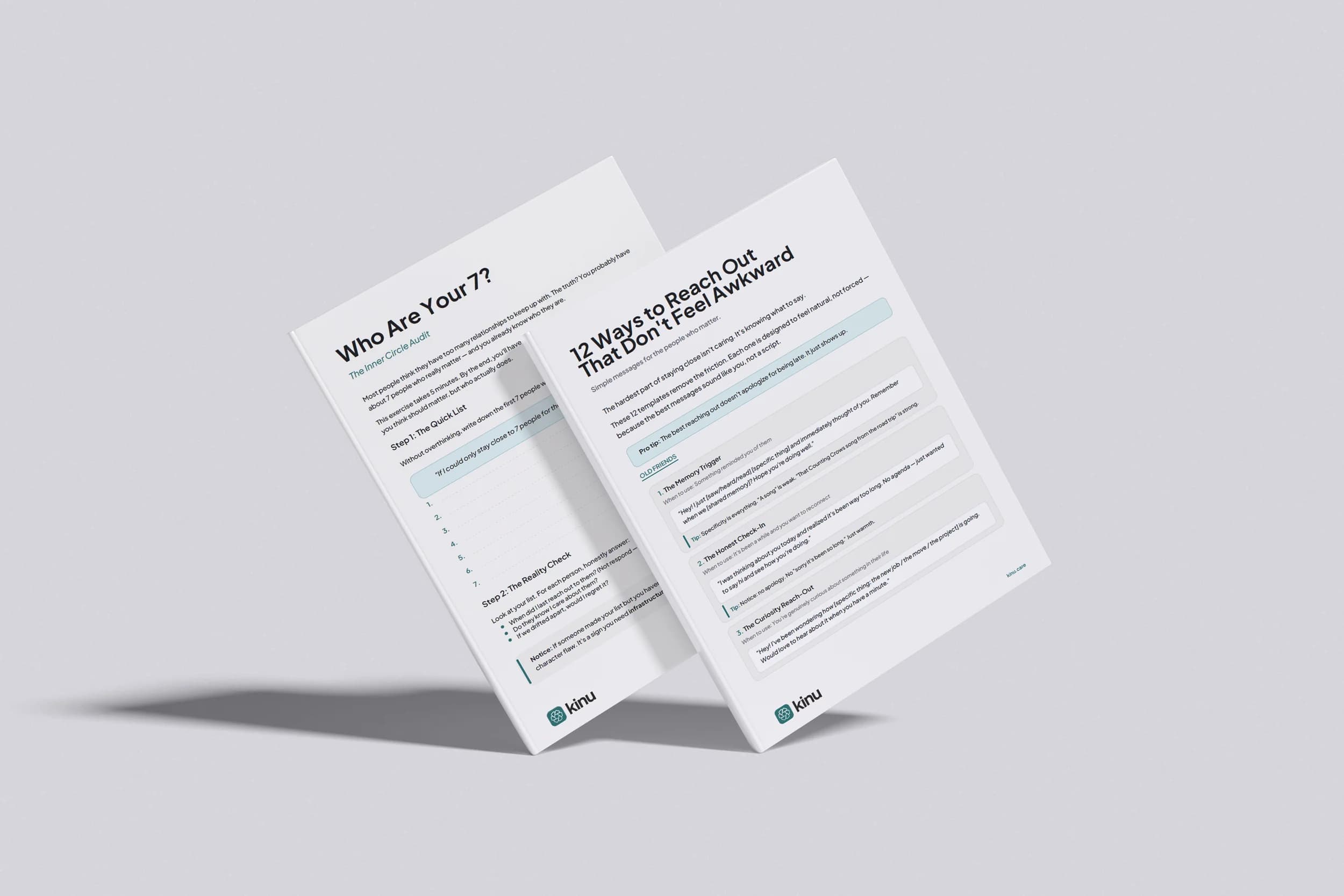
Kit de Reconexión gratis
Encuentra tu círculo cercano en cinco minutos.
Un ejercicio de 5 minutos para encontrar tu círculo cercano y 12 plantillas para escribirles sin que se sienta forzado. Gratis, descarga inmediata.
Descarga inmediata. Sin spam. Cancela cuando quieras.
Sigue leyendo

Por qué creé Kinu: los veranos junto al mar y las pequeñas cosas
Dos meses al año en la costa croata me enseñaron cómo es la amistad en su mejor momento. Aquí cuento por qué construí Kinu, y para quién.

Cómo mantener tus amistades con un bebé recién nacido
El bebé no termina tus amistades. La espiral de cortesía mutua sí. Cómo conservar a tu gente a través del túnel del recién nacido, en unidades lo bastante pequeñas para sobrevivirlo.

Por qué recordar las pequeñas cosas es el verdadero lenguaje del amor
Los detalles recordados hacen algo que los grandes gestos no pueden: demuestran atención sostenida. La investigación detrás de su peso desproporcionado.