The Most Private Personal CRMs (Local-First, No Cloud Required)
A personal CRM is the most sensitive database you'll ever own. The options that keep it on your device or your server, and the questions to ask any of them.
The most private personal CRMs keep your data on your device or your own server. Self-hosted Monica gives full control at the cost of running it yourself. Hippo stays entirely on-device, Apple only. Kinu is local-first on iOS and Android, with sync that's optional and encrypted on your device first. The least private options are the ones that read your inbox, which is most of the category.
Here is the full privacy map, and the five questions to ask before trusting any app with your people.
Think about what actually goes into a personal CRM: who you love, whose marriage is struggling, who got the diagnosis, what your friend told you the night she really talked. It is plausibly the most sensitive database you will ever create, more revealing than your photos and more permanent than your messages.
Now look at how most of the category handles it.
Disclosure: Kinu is our product and appears below. We've been precise about what every option, including ours, can and cannot promise.
Why Personal CRMs Have a Privacy Problem
The flagship feature of the mainstream personal CRM is ingestion. Connect your email. Connect your calendar. Connect LinkedIn. The product's magic, auto-enriched profiles and AI-suggested follow-ups, only works because the app reads your actual communications and builds its database from them.
That's not an accusation of bad faith; it's an architecture. Tools like Dex and Mesh are upfront about it, and for professional networking the trade can be rational. But it means the default personal CRM is a cloud service that processes your correspondence to model your relationships, and "private" was never the design goal. If that sits wrong for a database of the people you love, you're not paranoid. You're the target reader of this page.
What "Private" Actually Means Here
Four levels, from strictest to loosest:
- On-device only. The data never leaves your phone. No account, no server, nothing to breach remotely. The cost: no sync, and losing the device can mean losing the data.
- Local-first with opt-in encrypted sync. The data lives on your device by default; if you choose sync, it's encrypted on your device before upload and protected in transit and at rest. You trade a small, defined surface for backup and multi-device access.
- Self-hosted. The data lives on a server you control. Total ownership, real sysadmin responsibilities.
- Cloud with promises. The data lives on the company's servers under the company's policy. Could be handled well. The point is that the guarantee lives in a document, not in the design.
Everything below sits in levels 1 through 3.
Quick Comparison
| Privacy model | Platforms | Price | |
|---|---|---|---|
| Kinu | Local-first; opt-in encrypted sync | iOS, Android, Web | Free up to 10 people; Plus $69.99/yr |
| Hippo | On-device; optional sync via your own iCloud | iPhone, iPad, Mac | $14.99 a year / $29.99 once / 1-month trial, no free tier |
| Monica (self-hosted) | Your server, your rules, open source | Web | Free + hosting costs |
| Plain local files | Whatever you make it | Everywhere | Free |
| Mainstream cloud CRMs | Cloud + inbox/calendar ingestion | Varies | $120-240/yr typical |
The Options, In Detail
Kinu
A note on category: Kinu is a personal CRM in the plain sense of the words, a private place for notes, dates, and the little things about your people. What it is not is a sales tool: no pipeline, no contact import pressure, no networking vocabulary. If you searched "private personal CRM," this is the category it was built for.
The privacy model is structural, not a policy promise. Your relationship data stays on your device unless you opt into encrypted sync; synced data is encrypted on your device first and protected in transit and at rest. Kinu never asks for your inbox, calendar, or social accounts, because the entire product is built on what you choose to write down, not on ingestion. Your relationship content is not used for analytics, ads, or social features, and private notes are excluded from all processing entirely.
It is local-first on both iOS and Android, which nothing else here is.
People who want private, structured memory for their relationships on any phone, without running a server.
Not a CRM for managing hundreds of professional contacts, by design. Sync between devices requires Plus.
Hippo
Hippo is level one: notes and events about your people, stored on your device, with no account at all. If you want sync between your own devices, it runs through your personal iCloud Drive rather than Hippo's servers, which is an elegant way to offer convenience without becoming a custodian of your data.
The model's strengths are also its boundaries: Apple devices only, no path to Android or the web, and the no-account design means responsibility for the data's survival is entirely yours.
Apple-only users who want the strictest consumer option available.
No Android, no web. Paid after the trial month.
Monica, self-hosted
Monica self-hosted is the control maximalist's answer: an open-source personal CRM running on hardware you choose, with code you can audit. Nothing about your relationships exists anywhere you don't administer. For the right person, that sentence is the whole sales pitch.
The costs: setup is a real project (server, database, maintenance, backups), there's no native mobile app for capture in the moment, and the privacy guarantee is only as good as your own server hygiene. The $9/month hosted version exists, but note what it is: an ordinary cloud service, level four like any other.
Self-hosters who already run their own services and want relationships in the same trust domain.
A sysadmin project, not an app install. No native mobile capture.
Plain local files
The DIY route deserves naming: a folder of text files, one per person, in Obsidian or any editor, synced however you already sync files. Total format ownership, zero vendors, readable in fifty years.
What you give up is everything an app does on its own: no reminders before dates, no nudge when it's been months, no structure connecting people to time. It's the most private option and the most inert one, which is a fine trade for some and a silent failure mode for most.
If you want the whole field rather than only the private options, our Notion personal CRM comparison puts all 23 dedicated apps in one table.
Plain-text people with strong existing habits and their own sync setup.
Nothing comes back on its own. You are the reminder system.
Five Questions to Ask Any Relationship App
Whatever you pick, including anything that launches after this post, the audit is five questions:
- Does it demand my contacts, inbox, or calendar to function? Ingestion is the single biggest privacy decision an app makes. An app built on what you type can be private. An app built on what it reads cannot.
- Where does my data live at rest? On the device, on my server, or on theirs? "Bank-level encryption" without an answer to where is marketing, not architecture.
- If it syncs, when does encryption happen? "Encrypted on your device before upload" and "encrypted on our servers" are different promises. Ask for the first.
- What gets processed, and for what? Reminders need your dates. Nothing about a relationship app requires your content to feed analytics, advertising, or model training. Look for an explicit statement.
- Can I leave with my data? Export in an open format is the difference between a tool and a hostage situation.
Any app that answers all five plainly is taking the problem seriously, whoever makes it.
Which One Should You Pick?
- Any phone, structure and reminders, no server to run: Kinu.
- Apple-only and absolutist about on-device: Hippo.
- You already self-host and enjoy it: Monica on your own box.
- Plain-text forever, vendors never: the files-and-folders route.
- You genuinely need professional CRM ingestion: accept the trade with open eyes, and keep the people you love in a different kind of tool than the network you manage.
Privacy is one axis. If you want the whole field on one screen instead, our roundup of the best personal CRM for friends and family prints every price next to the vendor page it was read from, and states the rule the table is ordered by.
The category will keep telling you that more access means more magic. For work contacts, sometimes. For the people whose surgeries, struggles, and small joys fill these notes, the private options above prove you never needed to hand over your inbox at all.
We keep our own people in Kinu, which is the plainest endorsement we can offer: private by default, calm by design, on both platforms. Free for your first 10 people on iOS and Android. Here it is.
Frequently Asked Questions
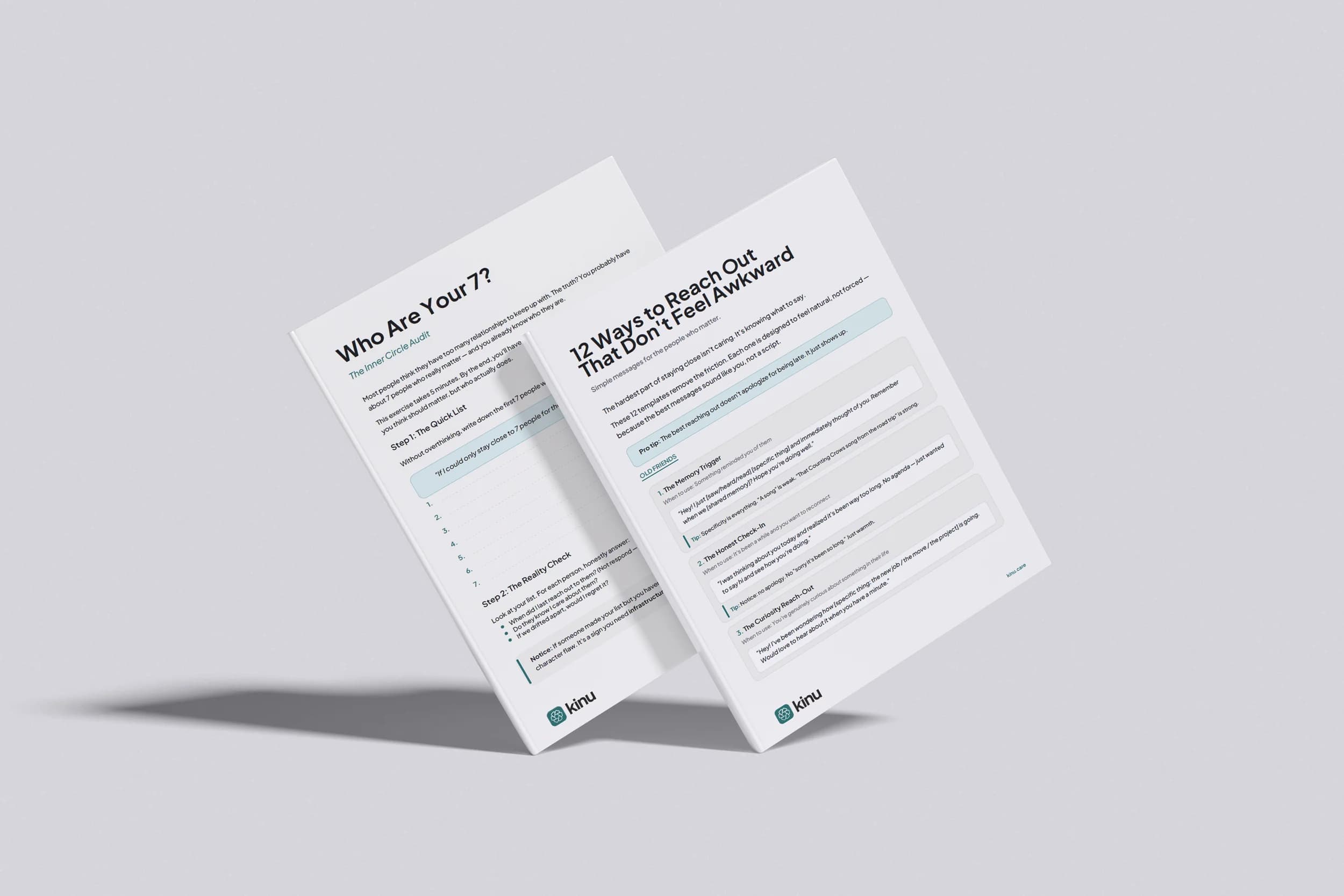
Free Reconnection Kit
Find your inner circle in five minutes.
A 5-minute exercise to find your inner circle and 12 reach-out templates that sound like you. Free, instant download.
Instant download. No spam. Unsubscribe anytime.
Keep reading

Best Gift Idea Tracker Apps (2026)
The gift tracker category splits three ways: wishlist apps, tiny dedicated trackers, and apps that catch hints year-round. An honest map of all three.
Best Apps to Remember Things About People (2026)
Seven honest options compared: private memory apps, on-device note keepers, name trainers, and when a plain notes app is all you need.
Personal CRM for Friends and Family: The Lists Are Written by the Apps
Every roundup in this category is published by one of the apps in it, this one included. Here is the map, ordered by a rule you can check, with every price read from the product's own page.