The Anti-Social Network: Apps That Help You Connect Without the Feed
Social media promised connection. It delivered feeds. Here are apps designed for actual relationships: no scrolling, no algorithms, no performance.
Social media was supposed to keep us connected. Instead, it gave us a feed.
You know the difference. A feed shows you what's trending, what's popular, what an algorithm thinks will keep you scrolling. Connection is knowing that your friend's mom is sick, that your college roommate just had a baby, that your neighbor is going through something hard.
Feeds and connection aren't the same thing. They're barely in the same category. And a growing body of research is confirming what millions of people already feel: the more time we spend on social feeds, the less connected we actually are.
But here's the thing. Most people aren't looking to quit social media entirely. They're looking for alternatives that serve the need social media promised to fill. Tools that help them stay close to people, not scroll past them.
This is the anti-social network space. And it's growing fast.
What "Anti-Social Network" Actually Means
An anti-social network isn't anti-social. It's anti-feed. It strips away the parts of social media that don't serve real relationships (algorithmic timelines, public performance, engagement metrics, ads) and keeps the part that does: connecting you with people you actually care about.
The term borrows from Cal Newport's concept of digital minimalism: technology should serve your values, not exploit your attention. An anti-social network applies this to relationships specifically.
No Feed
Nothing to scroll. No algorithmic timeline deciding what you see. You choose who to focus on and when.
No Audience
Your relationships aren't public. There's no follower count, no likes, no social performance. What you share is between you and the people you choose.
No Engagement Metrics
The app isn't measuring how much time you spend inside it. Success means you spent more time connecting with actual people, not more time on the app.
Privacy by Default
Your relationship data is among the most personal data you have. Anti-social tools treat it that way: with local storage, encryption, or both.
Five Tools That Flip the Social Media Script
Kinu
Kinu is a calm, private relationship companion and the purest expression of the anti-social network idea. No feed, no followers, no algorithm.
You add the people you care about. Kinu holds them for you. It surfaces who you haven't connected with in a while, stores context about your relationships (moments, important dates, notes), and gives you both a mobile and desktop experience designed for different modes of caring: quick check-ins on your phone, deeper reflection on your computer.
Everything stays on your device by default. If you want cross-device sync, it's encrypted before it leaves your device. There are no ads. No data selling. No public profiles.
Where most social networks optimize for engagement, Kinu optimizes for presence: being aware of who matters and staying close to them in a way that doesn't demand constant attention.
People who want a calm, private alternative to social media for relationship maintenance. If feeds make you feel worse, this is your antidote.
Newer product, so the community is still small.
Kinu is a calm, private relationship companion with no feed, no followers, and no algorithm. Pricing: Free for up to 10 people, $69.99 per year for Kinu Plus. Platforms: iOS, Android, Web. Best for people who want a calm, private alternative to social media for relationship maintenance.
BeReal
BeReal gained traction as the anti-Instagram: one unfiltered photo per day, at a random time, with no option to curate or retouch. The concept forces authenticity over performance.
It's not exactly a relationship tool. You're still broadcasting to a group rather than connecting one-to-one. But it removes the polish that makes social media feel performative, which makes interactions feel more genuine.
The limitation: it's still a feed. It's just an honest one. You're still scrolling through other people's content. The anti-social ethos is strong, but the architecture is still fundamentally feed-based.
People who want authenticity in their social sharing without the curated highlight reel.
Still feed-based. Limited to photo sharing.
BeReal is a photo-sharing app that prompts one unfiltered photo per day at a random time, removing the curation and performance of traditional social media. Pricing: Free. Platforms: iOS, Android. Best for people who want authenticity in their social sharing without the curated highlight reel.
Marco Polo
Marco Polo works like video voicemail for groups: you record short videos that friends watch when it's convenient, and they respond in kind. No scheduling. No real-time pressure. No written messages to overthink.
It's the closest digital equivalent to being in the same room as someone, minus the coordination required for live video calls. Groups use it for family updates, friend groups, and maintaining connections across time zones.
The video format carries emotional information that text strips away: facial expressions, tone of voice, the specific way someone laughs. That matters more for relationship maintenance than most people realize.
Families and friend groups who want more than text but can't coordinate schedules for calls.
Requires friends to adopt it too. Video isn't for everyone.
Marco Polo is a video messaging app that works like asynchronous video voicemail, letting you record and watch short videos with friends and family on your own schedule. Pricing: Free with premium features. Platforms: iOS, Android. Best for families and friend groups who want more than text but cannot coordinate schedules for calls.
Slowly
Slowly recreates the pen pal experience: you write letters that take time to "deliver" based on geographic distance. A letter to someone in your city might arrive in hours. A letter to someone across the world might take days.
It's intentionally slow in a space that rewards speed. And the slowness changes how people write: longer, more thoughtful, more like actual letters and less like chat messages.
Slowly is more about meeting new people than maintaining existing relationships, but its philosophy is deeply anti-social: depth over speed, quality over quantity, one person at a time.
People who want meaningful new connections without the swiping and matching of social apps.
Better for new connections than existing friendships.
Slowly is a digital pen pal app where letters take time to deliver based on geographic distance, encouraging thoughtful, long-form communication. Pricing: Free with premium features. Platforms: iOS, Android. Best for people who want meaningful new connections without the swiping and matching of social apps.
Locket
Locket puts a widget on your home screen that shows live photos from your closest friends. No feed to open. No app to scroll. Just a small, persistent window into someone else's day.
It's ambient. The connection happens passively, in the background of your life, rather than requiring you to open an app and actively engage. For close friends and family, this creates a sense of presence that social media feeds can't match.
Close friends and family who want passive, ambient connection throughout the day.
Limited to photo sharing. Requires matching widget adoption.
Locket is a widget-based photo sharing app that displays live photos from your closest friends directly on your home screen without opening an app. Pricing: Free with premium features. Platforms: iOS, Android. Best for close friends and family who want passive, ambient connection throughout the day.
The Pattern: What Anti-Social Tools Have in Common
Looking across these tools, a few principles emerge:
Small groups over broad networks. Every one of these tools works best with a small number of people: your inner circle, not your follower count. This aligns with Dunbar's research: humans can maintain roughly 5 close and 15 good friendships. Anti-social tools are built for Dunbar's number, not for scale.
Asynchronous over real-time. Most of these tools don't require both people to be available simultaneously. This is a crucial design choice. It respects the fact that deep relationships don't need constant contact, just consistent presence.
Private over public. None of these tools have a public-facing element. Your content isn't indexed, isn't searchable, isn't visible to anyone you haven't explicitly included. This changes behavior in ways that matter: people share more openly when they're not performing for an audience.
Calm over addictive. The business model is either subscription-based or free with no ads. This means the tool isn't optimizing for your attention. It can afford to let you leave.
Moving From Social Media to Anti-Social Tools
If you're considering the shift, here's a realistic approach:
Don't go cold turkey
Quitting social media entirely usually means losing the connection infrastructure it provides, however imperfect. A better approach: gradually replace the relationship maintenance function with tools designed for it, then reduce social media to the role it actually serves well (news, entertainment, discovery).
Start with your inner circle
You don't need to move all 800 Facebook friends to a new platform. Start with 5-10 people you genuinely want to stay close to. Move those relationships to a more intentional space. Leave the rest where they are.
Let the tools overlap
You might use Kinu to hold your people and remember important dates, Marco Polo for your family group, and BeReal with college friends. Different relationships benefit from different formats. The goal isn't one tool to rule them all. It's intentionality about which tools serve which relationships.
Measure by connection, not usage
Social media trains you to equate app time with social engagement. Anti-social tools work differently. The less time you spend in the app and the more time you spend actually connecting, the better. Judge the tools by whether your relationships feel closer, not by your screen time stats.
Frequently Asked Questions
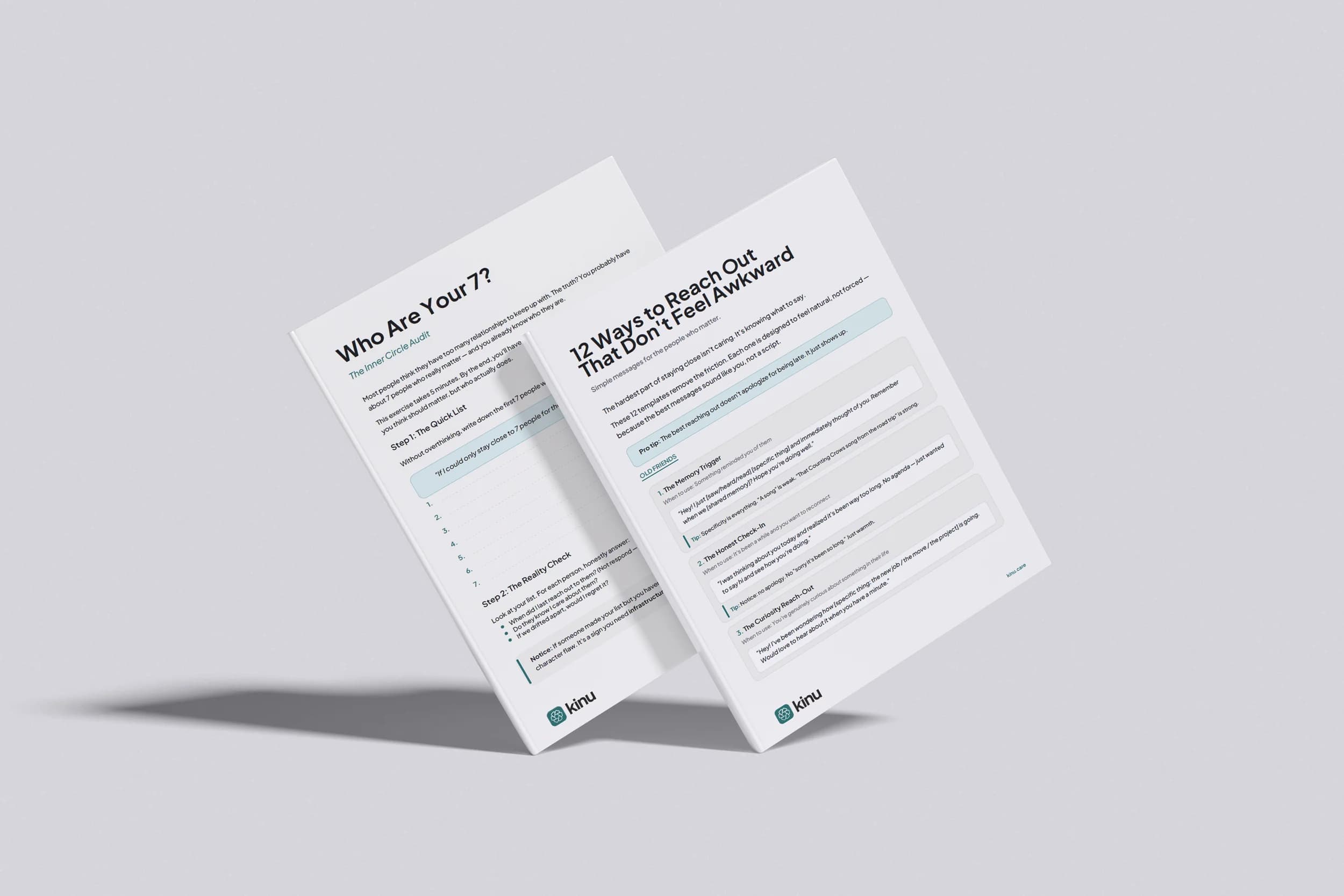
Free Reconnection Kit
Find your inner circle in five minutes.
A 5-minute exercise to find your inner circle and 12 reach-out templates that sound like you. Free, instant download.
Instant download. No spam. Unsubscribe anytime.
Keep reading
Personal CRM for Friends and Family: The Lists Are Written by the Apps
Every roundup in this category is published by one of the apps in it, this one included. Here is the map, ordered by a rule you can check, with every price read from the product's own page.
The Personal CRM Graveyard: Which Apps Shut Down, and Which Only Look Dead
UpHabit shut down its apps in April 2026. We checked eleven personal CRM apps, including our own, against primary sources, and two of the three shutdown claims we tested turned out to be wrong, including one of ours.
Notion Personal CRM vs 23 Dedicated Apps
Building a Notion personal CRM? See what the template does well, where it hits a wall, and 23 dedicated apps built to remember the people you care about.