Why Social Media Is Making You Feel Lonely (And What to Do Instead)
2025 research confirms what you already feel: social media use is linked to loneliness. Here's what the science says and practical alternatives that help.
You have 800 followers and feel more alone than ever.
You know something is off. You open Instagram, scroll for 20 minutes, put your phone down, and feel worse than before. Not dramatically worse. Just a little emptier. A little more disconnected from the people who actually matter to you.
You're not imagining it. Three major studies published in 2025 confirm what millions of people have been feeling for years: social media use is directly linked to loneliness, and the relationship is more complicated than we thought.
The 2025 research is hard to argue with
This isn't recycled advice from a 2018 blog post. The science got significantly more specific last year.
Adults in the top 25% of social media usage were twice as likely to report feeling lonely compared to lighter users. The study controlled for pre-existing loneliness, meaning the social media use itself was contributing to the isolation.
Both active use (posting, commenting, messaging) and passive use (scrolling, lurking, watching stories) were associated with increased loneliness. The distinction many assumed was protective just isn't there in the data.
Not all platforms are equal. Direct messaging tools like WhatsApp were associated with lower loneliness. But feed-based platforms like YouTube, Reddit, and Instagram were associated with higher loneliness. The difference? One-to-one communication versus broadcasting to an audience.
Loneliness carries health risks equivalent to smoking 15 cigarettes a day. We treat cigarettes as a public health crisis. We still treat social media as a lifestyle choice.
U.S. Surgeon General
Why scrolling feels like connection but isn't
Knowing the research is one thing. Understanding why it happens is what actually helps you change.
Social Snacking
Small hits of social contact that feel satisfying but don't nourish you. Liking a photo, watching a story. Each gives a tiny pulse of "I'm connected" without any real vulnerability or reciprocity.
Comparison Trap
Everyone's feed is a highlight reel. When you compare your messy Tuesday to someone else's best moment, the math never works in your favor. Over time, you don't just feel inadequate. You withdraw.
Displacement
Every 20 minutes scrolling is 20 minutes not spent calling a friend or having dinner with your partner. Social media doesn't just fail to provide connection. It takes time away from what does.
Performative Connection
Posting a birthday message on someone's wall feels like you did something. But did they feel closer to you? When we substitute performance for caring often enough, real relationships atrophy.
What actually helps (that isn't "just delete everything")
The answer isn't digital abstinence. That's not realistic for most people, and the New York Academy of Sciences research suggests it's not even necessary. The problem isn't technology itself. It's how we're using it.
Replace passive scrolling with direct contact
The research is clear: one-to-one communication reduces loneliness. Group feeds increase it. So the simplest shift is spending less time in feeds and more time in direct messages, voice notes, and calls.
Next time you catch yourself scrolling, try this: close the app, open your messages, and send one text to someone you actually care about. Not a meme. Not a repost. Something specific.
Hey, I was thinking about you. How's the new place?
It takes the same amount of time as scrolling. But you'll feel completely different after.
Set boundaries instead of quitting cold turkey
Total social media detox sounds appealing, and the 2024 JAMA Network Open study found it genuinely helps (participants saw a 24.8% reduction in depression symptoms after just one week). But most people can't sustain it.
What works longer term is structure. Specific times for checking social media. App timers that actually enforce limits. Removing apps from your home screen so you have to search for them. The goal isn't zero usage. It's intentional usage.
One approach that works well: keep messaging apps on your home screen. Move feed-based apps into a folder on your second screen. The friction is tiny, but it changes which one you default to when you're bored.
Create infrastructure for the relationships that matter
This is the part most advice articles skip. They tell you to "call your friends more" without addressing why you aren't already doing it.
The answer is usually simple: you don't have a system. Your relationships live in your head, scattered across apps, and maintained by willpower. When life gets busy, willpower is the first thing to go. And maintaining friendships as an adult is already hard enough without relying on pure willpower.
Some people keep a note on their phone with their closest people and a rough schedule for reaching out. Some use a simple reminder app. Some use tools like Kinu that are built specifically for this: a calm, private place for the little things about your people, without the noise of social feeds.
The format matters less than the principle: give your relationships somewhere to live outside your head.
Invest in one-on-one time, even when it's inconvenient
A 30-minute phone call with one friend will do more for your sense of connection than three hours on Instagram. You already know this. The challenge is choosing it when scrolling is so much easier.
Try scheduling it like you'd schedule a workout. Not because it should feel like a chore, but because important things that aren't scheduled tend not to happen. "Call Mom on Sunday at 11" is infinitely more likely to happen than "I should call Mom sometime."
The alternative isn't abstinence. It's intention.
Digital minimalism doesn't mean rejecting technology. It means choosing which technologies serve you and which ones just take. This philosophy has a name: calm technology.
Social media served a purpose when it connected you to people. For many of us, it stopped doing that a long time ago. It became a feed of acquaintances while the people who actually mattered got a text back three weeks too late. The data on this is striking. We're living through a friendship recession.
The shift isn't dramatic. You don't need to announce a digital detox or delete your accounts in a grand gesture. You just need to notice what makes you feel more connected and do more of that. And notice what makes you feel emptier and do less of it.
For most people, the answer is fewer feeds and more direct conversations. Less performing and more showing up. Less scrolling and more reaching out.
Start today. Pick one person you've been meaning to talk to. Call them, text them, send them a voice note. Not because an article told you to, but because you already wanted to. You just needed a nudge. If you're not sure what to say, here are 8 ways to check in on friends without it feeling forced.
Frequently Asked Questions
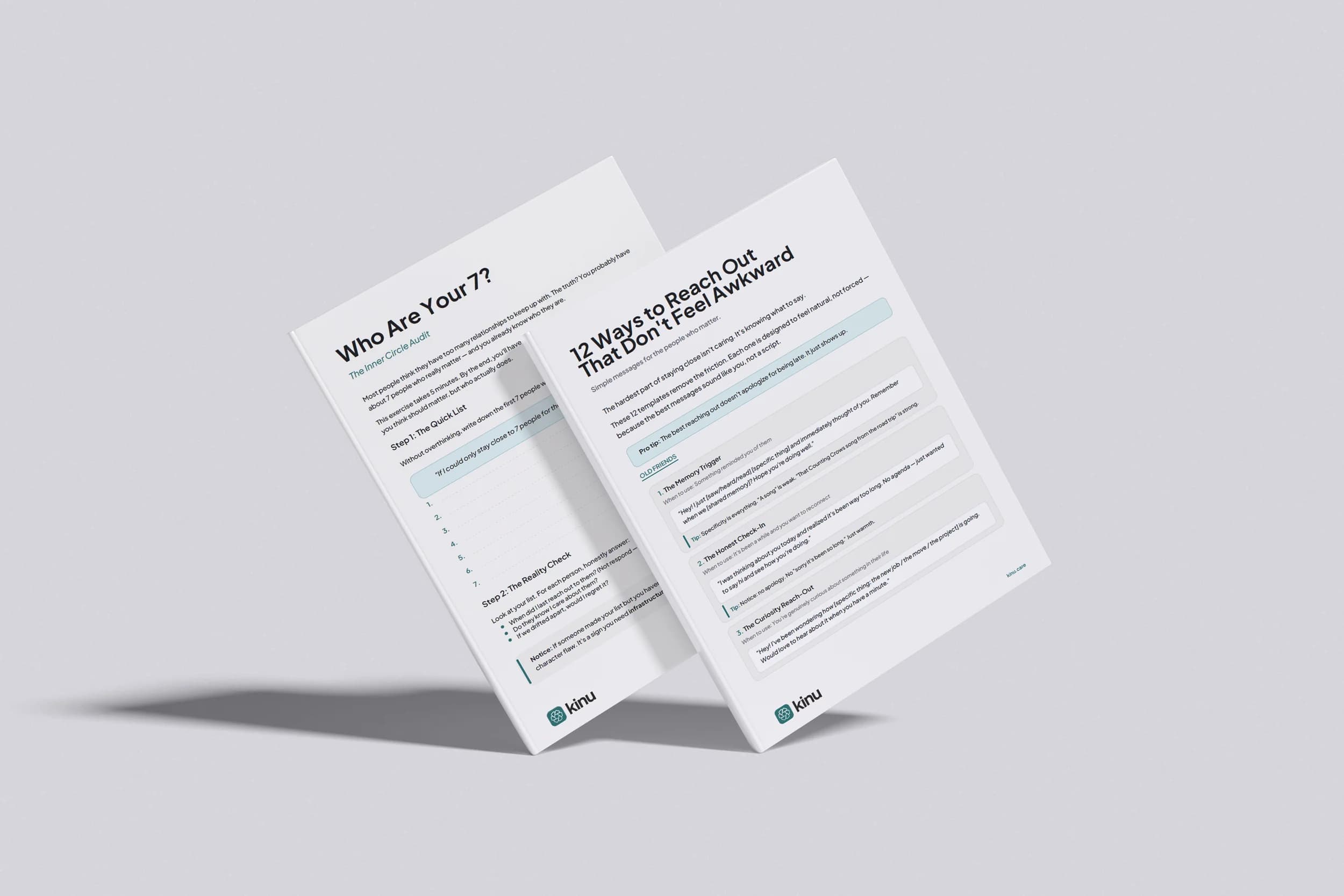
Free Reconnection Kit
Find your inner circle in five minutes.
A 5-minute exercise to find your inner circle and 12 reach-out templates that sound like you. Free, instant download.
Instant download. No spam. Unsubscribe anytime.
Keep reading
Quiet Quitting Social Media: How to Pull Back Without Disappearing
You don't have to dramatically delete everything. Here's how to quietly reduce your social media use while keeping the connections that actually matter.
How to Stop Doomscrolling (And What to Do With That Time Instead)
You know doomscrolling is bad for you. Here's why it's so hard to stop, what the research says about its effects, and practical replacements that stick.
Why I Built Kinu: Summers by the Sea and the Small Things
Two months a year on the Croatian coast showed me what friendship looks like at its best. This is why I built Kinu, and who I built it for.