How to Stop Doomscrolling (And What to Do With That Time Instead)
You know doomscrolling is bad for you. Here's why it's so hard to stop, what the research says about its effects, and practical replacements that stick.
Doomscrolling is hard to stop because it exploits two powerful psychological mechanisms at once: variable reward scheduling (the slot machine effect) and negativity bias (our wiring to fixate on threats). What works is breaking the reflex that opens the app, replacing the time with something that scratches a similar itch, and setting boundaries instead of outright bans.
It's 11:47 PM. You unlocked your phone to set an alarm. Twenty minutes later, you've read about three scandals, a wildfire, a celebrity divorce, and someone's take on a thing you didn't care about until the algorithm showed it to you.
You feel worse than before you picked up your phone. You also can't stop.
That's doomscrolling, and if it's become your default evening routine (or morning routine, or lunch break routine), you're not weak-willed. You're dealing with some of the most sophisticated behavioral engineering ever built.
Here's what's actually happening, why it's hard to stop, and (more importantly) what to do with all that recovered time.
Why It's Hard to Stop (The Science)
Doomscrolling exploits two psychological mechanisms simultaneously.
Variable Reward Scheduling
The same mechanism that makes slot machines addictive. You never know if the next scroll will bring something interesting, outrageous, funny, or scary. Your brain keeps pulling the lever because maybe the next one will be the payoff.
Negativity Bias
Humans are wired to pay more attention to threats than to neutral or positive information. Social media platforms know this. The algorithm doesn't care about accuracy; it cares about engagement. And threat keeps you engaged.
False news stories, which tend to be more outrageous and threatening, spread six times faster than true ones.
Combined, these create a loop: negative content grabs attention → attention signals "show more like this" → more negative content appears → repeat until your brain is too depleted to scroll anymore.
Even one week away from social media reduced depression symptoms by nearly 25% and anxiety by 16%.
How to Actually Stop (What Works)
Remove the reflex, not just the app
Most advice says "delete the app." That works for about three days, until you reinstall it or switch to the mobile browser version.
The real fix is breaking the reflex. You don't open Instagram because you decided to. You open it because your thumb has a habit loop: boredom → unlock phone → tap the spot where the icon is.
Fix the reflex:
- Move social apps off your home screen entirely (put them in a folder on the second page)
- Replace the icon position with something you actually want to do (a notes app, a meditation timer, a messaging app)
- Set your phone to grayscale mode after 9 PM (removes the visual dopamine hit)
- Use Screen Time (iOS) or Digital Wellbeing (Android) to add a friction step
Replace the time, don't just remove the habit
The biggest mistake people make: they create a void where doomscrolling used to be, and then wonder why they can't resist filling it. This is also why friendships fade. Without something to fill the gap, connections drift.
You need a replacement behavior that scratches a similar itch (low effort, somewhat engaging, accessible from the couch):
For the Information Itch
Subscribe to a daily newsletter you actually like (Morning Brew, Dense Discovery, The Browser). Read that instead.
For the Connection Itch
Text an actual person. Pull up your contacts and send a message to someone you've been meaning to reach out to. Takes 30 seconds, feels better afterward.
For the Boredom Itch
Keep a physical book next to wherever you usually scroll. Audiobooks and podcasts work too. The bar is just "more engaging than staring at the ceiling."
For the Wind-Down Itch
A crossword, Sudoku, or word game is low-effort engagement without the negativity spiral. Sounds boring. Works surprisingly well.
Set boundaries, not bans
Total abstinence sounds clean in theory. In practice, most people need some social media for legitimate purposes: staying aware of community events, keeping up with certain people, professional visibility.
The trick is time-boxing. Give yourself 15 minutes of intentional social media use per day (set a timer). Open the app, check what you specifically want to check, close it. No browsing. No feed scrolling. Check the specific accounts or groups you care about and leave.
This turns social media from a passive time-sink into an active tool. The difference is enormous. For a full playbook on this gradual approach, see our guide on quietly pulling back from social media.
What to Do With the Recovered Time
Most doomscrollers are spending 1-3 hours daily on feed-based scrolling. When you get even half of that back, the question becomes: what do you actually want to do with it? Here's what digital minimalism suggests:
Reconnect with Specific People
Not "be more social" in the abstract. Pick one person and reach out to them. A real conversation with one person beats an hour of parasocial scrolling every time.
Start the Thing You Keep Saying You'll Start
The journal. The guitar. The running. The side project. You didn't lack time. You lacked attention, and the algorithm was stealing it.
Do Literally Nothing
Boredom is underrated. It's where creativity and self-reflection happen. Letting your brain be unstimulated for 10 minutes is increasingly radical. And increasingly necessary.
Move Your Body
Even a 15-minute walk. The contrast between how you feel after scrolling vs. after walking is almost comically stark.
FAQ
If part of why you scroll is to stay connected, there are calmer alternatives. Kinu gives your relationships a private place to live, without feeds, ads, or algorithms. Try it free.
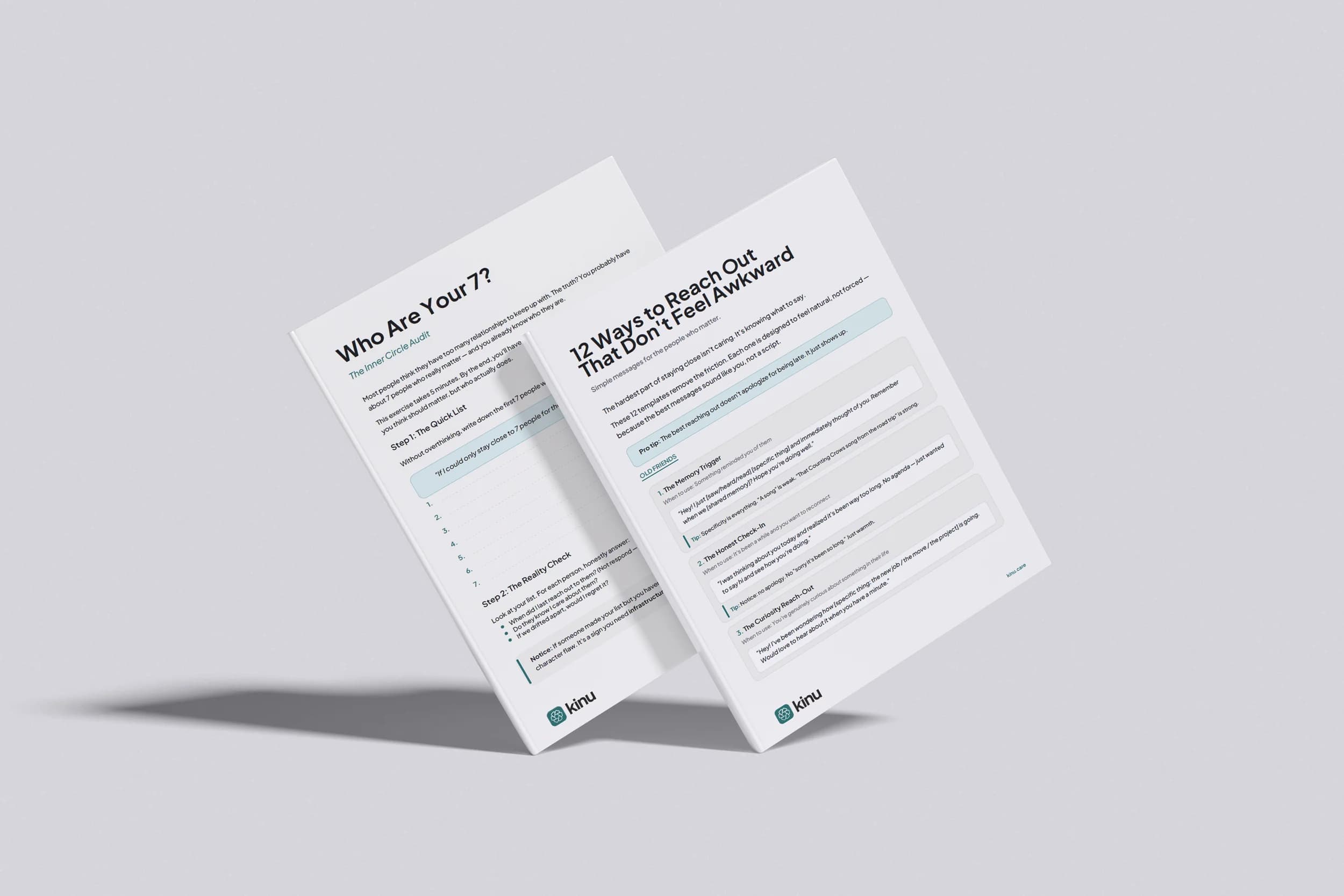
Free Reconnection Kit
Find your inner circle in five minutes.
A 5-minute exercise to find your inner circle and 12 reach-out templates that sound like you. Free, instant download.
Instant download. No spam. Unsubscribe anytime.
Keep reading
Quiet Quitting Social Media: How to Pull Back Without Disappearing
You don't have to dramatically delete everything. Here's how to quietly reduce your social media use while keeping the connections that actually matter.
Digital Minimalism for Relationships: Using Less Tech to Connect More
Digital minimalism isn't about quitting technology. It's about choosing tools that serve your relationships instead of exploiting your attention.
Best Digital Minimalism Tools and Apps (2026)
A curated list of apps, tools, and devices that help you use technology intentionally: from focus tools to relationship apps to hardware designed for calm.