Digital Minimalism for Relationships: Using Less Tech to Connect More
Digital minimalism isn't about quitting technology. It's about choosing tools that serve your relationships instead of exploiting your attention.
Digital minimalism for relationships means starting from what you value in your connections, then choosing only the tools that genuinely support those values. In practice, this usually means replacing passive social media consumption with direct, intentional communication and building simple infrastructure to keep your closest people visible.
Cal Newport's 2019 book Digital Minimalism gave millions of people a framework for their instinct that something about modern technology had gone sideways.
The core argument was simple: most of us use technology by default, adding apps and platforms without asking whether they serve our values. A better approach is to start from your values and choose only the tools that genuinely support them.
The book changed how many people think about social media, notifications, and screen time. But one area it barely touched, and where the philosophy applies most powerfully, is relationships.
Because here's the uncomfortable truth: for most people, the technology that's supposed to keep them connected to friends and family is actually getting in the way.
How Technology Harms Relationships (Without You Noticing)
It's not that technology is inherently bad for relationships. It's that the specific technologies most people use for social connection were designed for a different purpose: engagement.
Social Snacking
You know what your college roommate had for lunch in Barcelona. You've seen their vacation photos, their kid's first steps, their new haircut. But you haven't had a real conversation in two years. The platform gave you the feeling of staying connected while actually removing the motivation to reach out directly.
Quantity Without Quality
You're in 15 group chats, most of which are meme repositories. The volume of messages makes you feel socially active, but how many of those conversations involve genuine vulnerability, support, or depth? For most people, the answer is: almost none.
Fragmented Attention
Every buzz, banner, and badge pulls a tiny piece of your attention away from whatever, or whoever, you're with. Research shows that even the presence of a phone on a table during a conversation reduces empathy and connection between the people talking.
Pressure Without Presence
The expectation that you should respond to every message quickly creates anxiety about your inbox rather than enthusiasm about your relationships. You're managing response times, not nurturing connections.
The Digital Minimalist Approach to Social Connection
Digital minimalism for relationships means the same thing it means for technology in general: start from what you value, then choose tools that support those values. Everything else goes.
Define what connection means to you
Before evaluating tools, get clear on what you actually want from your social life:
Do you want a small number of deep, intimate friendships? Or a broader network of warm acquaintances? Both are valid, but they require different infrastructure.
What does "staying close" look like for you? Weekly phone calls? Monthly dinners? Knowing what's happening in someone's life without needing constant contact?
What drains you socially? Group text noise? Obligation to respond quickly? The pressure to post and perform?
Your answers to these questions become your filter for every tool and platform you use.
Audit your social technology
List every app, platform, and tool you use for social connection. For each one, ask:
- Does this help me do what I actually value in relationships? Or does it just make me feel like I'm connected while substituting real connection with something easier?
- Is this tool designed to serve my social goals? Or is it designed to serve its own engagement metrics?
- Does using this make me more likely to reach out to the people who matter? Or less likely (because I already "saw their update")?
Be honest. Most people discover that 80% of their social technology doesn't actually serve their relationships. It serves the platforms.
Replace default tech with intentional tech
This is where it gets practical. For each category of social need, choose the minimum effective tool:
For staying aware of close friends' lives: Direct conversation (phone, text, voice note) beats passive social media consumption. You learn more in a 10-minute call than from six months of Instagram stories.
For coordinating plans: A simple group text with your actual close friends beats a Facebook group, events platform, or group chat with 47 people.
For remembering who matters and when to reach out: A personal system, whether it's a note, a calendar, or a dedicated relationship app, beats hoping you'll remember.
For sharing meaningful moments: Sending a photo directly to the person it's about beats posting it publicly for everyone and no one.
The pattern: direct, intentional, private communication almost always serves relationships better than broadcast, passive, public platforms.
Create communication rituals
Digital minimalism creates a vacuum. You removed the tools that simulated connection. Now you need to replace them with practices that create actual connection.
Weekly Reach-Out
Twenty minutes, once a week, reaching out to 3-4 people. Not responding to messages, but initiating contact. This single habit does more for friendships than any app.
Monthly Deep Conversation
Block 60-90 minutes once a month for a real conversation with someone in your inner circle. Phone or video. No multitasking. Just two people catching up properly.
Seasonal Gathering
Once a quarter, bring together a small group of people who matter to you. Dinner, a hike, a game night. Physical presence is irreplaceable for relationship depth.
The Tool That Fits
There's a specific gap in the digital minimalist's toolkit when it comes to relationships.
You've removed social media (or reduced it dramatically). You've stopped relying on feeds and notifications to maintain awareness of your friends' lives. You're reaching out directly instead of broadcasting.
But you still need something to hold the context. Who haven't you talked to in a while? What did Sarah tell you last time about her job? When's your friend's kid's birthday?
This information used to live passively in your social media feed. Now that you've opted out of that, you need somewhere else for it to live.
A notes app works. A spreadsheet works. A dedicated relationship tool works best, if it's built on the same principles you're applying to the rest of your technology: calm, private, intentional, and designed to support your goals rather than capture your attention.
Kinu was specifically designed for this use case: a calm, private relationship companion for people who've opted out of social media's model but still want infrastructure for staying close. No feeds. No engagement metrics. No attention traps. Just your people, in one quiet place.
The Paradox of Going Against the Current
Being a digital minimalist about relationships means swimming upstream. Everyone else is on Instagram. Everyone else is in the group chats. When you pull back from these platforms, you risk becoming invisible, and some relationships might not survive the transition.
This is real, and it's worth acknowledging. Some connections that existed only through social media engagement will fade when you stop engaging. That's okay. Those connections were likely shallower than they appeared.
The relationships that survive your digital minimalism are the real ones. They're the people who notice when you reach out directly, who respond to phone calls, who make time for actual conversation. Those relationships almost always get deeper when you remove the noise of social media and replace it with direct, intentional contact.
"I felt a little sad giving up my 'real' network on there. But then I realized my real network was never on there at all. It was the 7 people I actually want to talk to."
That's digital minimalism for relationships in a sentence: finding your 7, and building your life around them.
Frequently Asked Questions
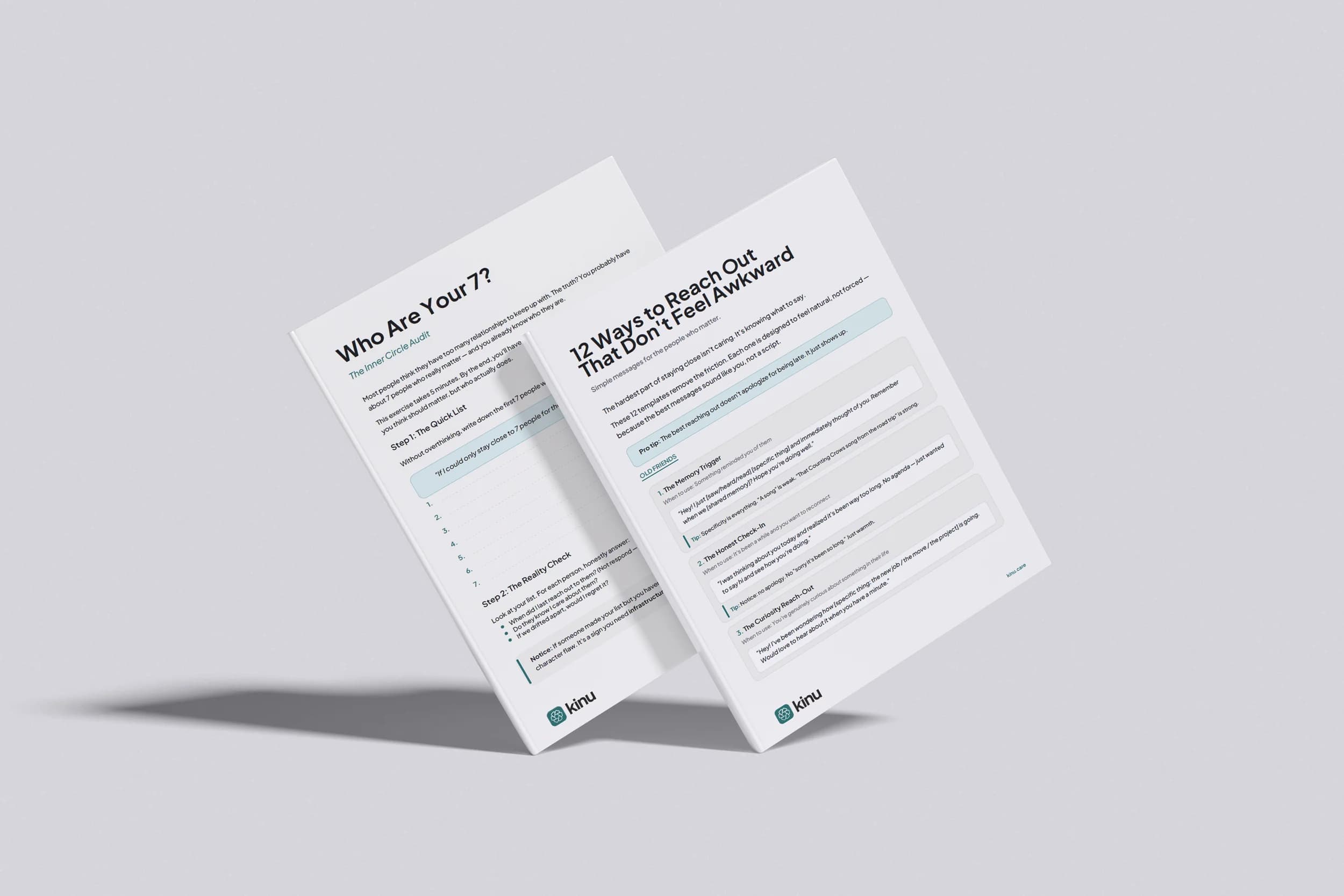
Free Reconnection Kit
Find your inner circle in five minutes.
A 5-minute exercise to find your inner circle and 12 reach-out templates that sound like you. Free, instant download.
Instant download. No spam. Unsubscribe anytime.
Keep reading
Quiet Quitting Social Media: How to Pull Back Without Disappearing
You don't have to dramatically delete everything. Here's how to quietly reduce your social media use while keeping the connections that actually matter.
How to Stop Doomscrolling (And What to Do With That Time Instead)
You know doomscrolling is bad for you. Here's why it's so hard to stop, what the research says about its effects, and practical replacements that stick.
Best Digital Minimalism Tools and Apps (2026)
A curated list of apps, tools, and devices that help you use technology intentionally: from focus tools to relationship apps to hardware designed for calm.