Monica CRM Alternative: Skip the Server, Keep the Privacy (2026)
Looking for a Monica CRM alternative? Kinu gives you Monica's privacy and depth without Docker, databases, or a $9 hosted plan. Here is the full comparison.
Is There a Monica CRM Alternative That Does Not Need a Server?
The short answer: if Monica's appeal was privacy and ownership but the friction was self-hosting, Kinu is the closest match. Local-first by default. Encrypted sync if you want it. No server to maintain. Mobile-first instead of web-only. Free for up to 10 people.
Disclosure: Kinu is our product. Monica's strengths and our limitations both get their own sections below.
Monica makes a promise very few apps can: your relationship data on your own server, under your own keys, running open-source code you can read. If that promise is why you are here, the real question is what it costs to keep. The answer, mostly, is your weekends.
This page is written for the people who love what Monica stands for and still do not want to be its sysadmin.
Monica vs Kinu at a Glance
| Monica (self-hosted) | Monica (Cloud) | Kinu | |
|---|---|---|---|
| Setup | Docker, database, server config | Sign up online | Download the app |
| Open source | Yes, on GitHub | Yes, same codebase | No (closed source) |
| Data location | Your server | Monica's servers | Your device (local-first) |
| Sync model | N/A (single server) | Server-side | Encrypted before upload |
| Mobile app | Web only | Web only | Native iOS + Android |
| Price | Free + hosting costs | $9 / month | Free up to 10 people, $69.99/yr unlimited |
| Technical skill needed | High | None | None |
| Best for | Developers who love self-hosting | Web-CRM users | Calm, private, personal use |
If you want maximum data control and you enjoy infrastructure, stick with Monica self-hosted; the software earns its reputation. The rest of this page is for everyone who wants Monica's spirit without Docker.
Where Monica Asks Too Much
Monica's core idea is right. Relationships deserve a dedicated place. Most messaging apps, address books, and notes apps fail at that job. But a few specific frictions keep pushing people to look elsewhere.
Self-hosting is a wall
The free version requires Docker, a database, and ongoing server maintenance. For non-technical people, the install guide reads like a job description.
Cloud removes the wall, not the limits
Monica's hosted plan at $9 per month is reasonable. But you trade self-hosting for a web-only experience. No native mobile app. No quick check-in on the go.
The interface is CRM-shaped
Monica treats relationships like a database. Contacts, fields, activities, notes. Powerful for some people. Heavy for anyone who just wants to remember their sister's new job.
Development pace is slow
Monica is community-led and unfunded. Its main branch has had no new commit since August 2025, and the long-promised next major version is still in development.
Monica deserves the benefit of every doubt here: it is one of the few apps in this category you can audit line by line, and it has kept its principles through years when funded competitors traded theirs away. The question is narrower than loyalty: do those principles require running your own server? For most people, the answer is no.
Monica's Spirit Without the Server
Kinu started from the same belief as Monica. Your relationships deserve a private home that is not a social feed. The execution is different in three specific ways.
1. Local-first instead of self-hosted
Your data lives on your device by default, not on Monica's server and not on ours. That gives you the same ownership as self-hosted Monica without making you the sysadmin. If your phone is in your pocket, your data is in your pocket.
When you turn on sync to use Kinu across devices, everything is encrypted on your device before it ever leaves your phone. The server stores opaque blobs, and we do not access your relationship content (how the encryption works). This is a different privacy model than self-hosting, but it is real. (More on the philosophy of calm, private tools if you want the long version.)
2. Mobile-first instead of web-only
Monica lives in a browser tab. Kinu lives on your phone. You check in on your people the way you check in on a text thread. Quick. Calm. No login flow. (Desktop access is available on Kinu Plus for longer writing sessions.)
Most of the moments worth writing down happen away from a desk: you bumped into a friend, or remembered something your dad said last weekend, and want to jot it down before it goes. A web-only CRM misses those moments.
3. Warmth instead of database fields
Monica is a personal CRM built around a database you administer. Kinu is a personal CRM for your personal life, closer to a relationship companion. It changes what the app feels like.
Where Monica gives you contacts and activities, Kinu gives you the Relational Compass: your people arranged by how close you actually are, each carrying an intention (closer, maintain, distance) and an energy mode the app adapts to. No streaks. No urgency. Nobody's name with an overdue number beside it.
Other Kinu features that map roughly to Monica:
| Monica concept | Kinu equivalent |
|---|---|
| Contact | Person |
| Activity | Moment (light observations worth remembering) |
| Reminder | Important date + opt-in nudge |
| Note | Private Note (never processed by the system) |
| Tag | Lens (Family, Friends, Work, custom) |
The words are doing deliberate work there. Why we built Kinu has the full reasoning.
How to Migrate from Monica to Kinu
There is no automated importer yet. We are working on it. Here is how the move usually goes.
Export from Monica
Monica has a SQL export under Settings. If you are on the cloud version, you can also request a data export. You will get a structured dump of your contacts, activities, and notes.
Start with your inner circle
Do not try to migrate every contact. Kinu is for the people who matter. Start with the handful you would genuinely miss, and add more if and when you need to.
Re-enter, do not re-import
Re-entering a person in Kinu takes about 60 seconds. Name, lens, closeness, important dates, one or two moments. The act of typing it out is part of the value. You will remember more.
Park the rest in Private Notes
For people you want to keep around without active maintenance, set their mode to "paused" and put any context in their Private Note. Kinu will not nudge you. They are still there when you want them.
Trade-offs
Where Monica is better than Kinu
- Full data export and ownership in one file. Self-hosted Monica gives you a SQL database. You can do anything with it. Kinu gives you encrypted sync blobs plus on-device data, which is private but less portable today.
- Open source. Monica's code is on GitHub. You can audit it, fork it, contribute to it. Kinu is closed source today. We may change this for the core sync and encryption layer.
- No vendor risk. If our company disappears, Kinu's local data still works but cloud sync stops. If Monica's company disappears, your self-hosted server keeps running forever.
- Comprehensive CRM features. Monica has gift tracking, reminders, debt tracking, journal entries, and more. Kinu is intentionally narrower.
- Browser-first if that is your preferred surface. Kinu Plus has web access, but the experience is built for mobile.
Where Kinu is better than Monica
- No setup. Download, sign in, start. Zero infrastructure.
- Native mobile. iOS and Android apps built for thumbs.
- Encryption without self-hosting. Your data is encrypted before sync. You get privacy without owning a server.
- Calmer model. No streaks. No urgency. Modes for different life seasons. (We have written about calm technology if you want the principle behind this.)
- Free tier that works. 10 people, all core features, indefinitely, on your phone or on the web; sync is the Plus add-on. Monica's free tier requires you to host it.
- Active development. Kinu shipped version 1.4.3 on 15 September 2026, nine weeks after launch. Monica's next major version has been in progress for years.
Other Monica Alternatives Worth Knowing
If neither Monica nor Kinu is the fit, here are the credible options. We covered these in depth in our personal CRM vs relationship apps guide.
Dex
Dex is the closest hosted equivalent to Monica's full feature set. LinkedIn import, email integration, contact enrichment, AI conversation starters. The vocabulary stays CRM-heavy, which is great if Monica's structure was what you liked, and less great if you wanted something warmer.
People who want Monica's comprehensiveness without self-hosting and do not mind the CRM framing.
No free plan, only a 7-day trial. Premium is $12 a month billed annually, $20 monthly. Professional framing throughout.
Clay (now Mesh)
Clay was acquired by Automattic in 2025 and rebranded Mesh. AI builds rich profiles automatically from your email, calendar, and social accounts. Best in class for professional networking. The privacy trade-off is real: Clay needs broad access to your communication data to work.
Professionals with large networks who want automation.
No Android. AI features feel invasive if you came to Monica for privacy reasons.
UpHabit
UpHabit shut down its personal CRM apps on 9 April 2026; the closure note is still on its homepage and the store listings no longer resolve. It stays in this list only as a caution: eight years of work and a pivot toward enterprise relationship selling, and it closed anyway. If you are coming from UpHabit, we wrote up where its users are landing.
No longer an option. If you still have it installed, export your contacts now.
Closed. Already-installed apps keep working for the moment, but do not count on reinstalling.
Whichever alternative makes your shortlist, check its pulse before your notes move in. Apps in this category go quiet without announcing it, and our hand-verified record of which personal CRMs shut down is the fastest way to rule out the risky ones.
For the wider field beyond this one head-to-head, including apps built specifically for the friends-and-family case, see our roundup of personal CRM apps for friends and family, ordered by a rule you can check rather than by whoever wrote the list.
Reasons to Stay with Monica
Not everyone reading this should switch.
Stay with Monica if:
- You enjoy self-hosting and already run other services on a home server or VPS.
- Open-source matters to you as a principle, not just an outcome. You want to be able to audit the code or contribute.
- You want maximum data portability in standard formats (SQL, JSON).
- You need the full CRM feature surface: gift tracking, debt tracking, detailed activity logging.
- You are comfortable with the web-only experience and do not need a native mobile app.
Switch to Kinu if:
- You loved Monica's privacy story but bounced off the setup.
- You want a native mobile app.
- You want something calmer and more focused than a full CRM.
- You want a free tier that works without hosting your own server.
- Your list is a couple dozen people, not hundreds.
The Deciding Question
If your relationship to your data is "I want to own it," Monica self-hosted is right. If your relationship to your data is "I want it to stay private without becoming my second job," Kinu is right.
Try Kinu Free
If Monica's vision resonated but the setup did not, Kinu is free for up to 10 people on iOS, Android, and the web. No credit card. No server. No Docker. You add the people who matter. Kinu helps you keep the little things about them and brings them back when they matter.
For more on the underlying ideas, see our pieces on how to maintain friendships as an adult and the best apps for staying in touch.
Frequently Asked Questions
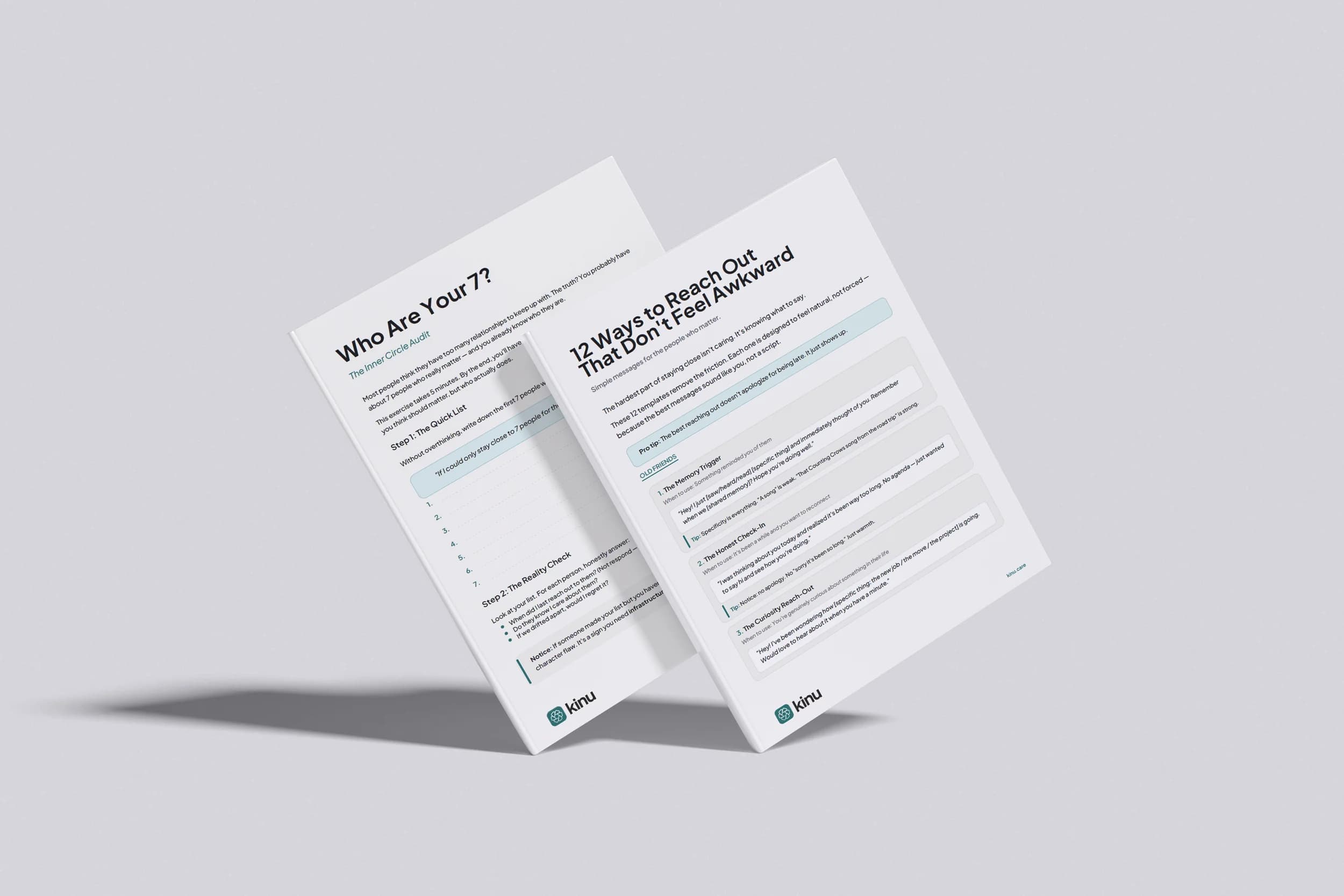
Free Reconnection Kit
Find your inner circle in five minutes.
A 5-minute exercise to find your inner circle and 12 reach-out templates that sound like you. Free, instant download.
Instant download. No spam. Unsubscribe anytime.
Keep reading
Personal CRM for Friends and Family: The Lists Are Written by the Apps
Every roundup in this category is published by one of the apps in it, this one included. Here is the map, ordered by a rule you can check, with every price read from the product's own page.
The Personal CRM Graveyard: Which Apps Shut Down, and Which Only Look Dead
UpHabit shut down its apps in April 2026. We checked eleven personal CRM apps, including our own, against primary sources, and two of the three shutdown claims we tested turned out to be wrong, including one of ours.
Notion Personal CRM vs 23 Dedicated Apps
Building a Notion personal CRM? See what the template does well, where it hits a wall, and 23 dedicated apps built to remember the people you care about.