Clay (Now Mesh) vs Kinu: The Head-to-Head (2026)
Clay rebranded to Mesh. Here is what changed, what it costs now, and how it compares to Kinu for private, calm relationship care on iPhone and Android.
Clay and Kinu get compared because they promise the same outcome: staying close to the people in your life. Under the hood they are nearly opposite apps. Clay (now Mesh, after the Automattic acquisition in June 2025) is an AI-powered networking tool; Kinu is a calm relationship companion.
If Clay's AI intrigues you and its appetite for your email and calendar gives you pause, both reactions are fair. Which one weighs more is the whole decision, and this page is built around it.
The short answer: if Clay's appeal was staying on top of a professional network at scale, stick with Clay or Mesh. If Clay's appeal was finally having a home for the people who matter but the AI scraping and the iOS-only release stopped you, Kinu is the closer match. Local-first. Encrypted sync. iOS and Android. Free for up to 10 people.
Disclosure: Kinu is our product.
What happened to the Clay app?
Clay rebranded to Mesh after Automattic, the company behind WordPress.com, acquired it in June 2025. The product, team, and direction stayed the same: AI-driven networking and professional relationship management. The clay.earth domain now redirects to me.sh, and pricing changed with the rebrand. The free Personal plan covers up to 1,000 contacts, and Pro is $10 a month for unlimited contacts. Everything in this comparison reflects Mesh as it works today.
Clay's rebrand had a soft landing. Not every app in this category gets one: we keep a hand-checked record of which personal CRMs shut down and which only look dead, verified against the stores and the products' own announcements.
Clay vs Kinu at a Glance
| Clay (now Mesh) | Kinu | |
|---|---|---|
| Built for | Professional networking at scale | Personal relationships that matter |
| Core model | AI-enriched CRM | Calm, local-first companion |
| Data approach | Auto-imports from email, calendar, LinkedIn, social | Manual or phone contacts, your choice |
| Privacy model | Cloud + broad communication access | Local-first, encrypted sync |
| Platforms | iOS, macOS, Windows, Web | iOS, Android, Web |
| Price | Free / $10 a month | Free up to 10 people, $69.99/yr unlimited |
| AI features | Extensive enrichment and suggestions | Minimal, opt-in nudges only |
| Best for | Founders, investors, BD, sales | Anyone who wants calm, private connection |
If you want automation, enrichment, and a CRM that thinks for you, Clay is great at that job. If you want a quiet home for the people you care about, keep reading.
Why People Leave Clay
Clay is a serious product with a clear point of view. But three things push people to look elsewhere, and a fourth has gotten louder since the acquisition.
The privacy cost is real
To build those rich profiles, Clay needs broad access to your email, calendar, LinkedIn, and social accounts. That works for professional networking. It feels invasive when the people you care about are your sister, your college friend, and your neighbor.
No Android, still
Clay is iOS, macOS, and Web. If you use Android, you are not the customer. After the Mesh rebrand, the roadmap has not changed.
The framing is professional
Clay's vocabulary is network, connections, leverage, follow-up. Powerful for sales and BD. Heavy for someone who just wants to remember their dad's new hobby.
Pro pricing is built for professionals
Mesh Pro is $10 a month for unlimited contacts. For a founder or investor, that pays for itself in one warm intro. For a personal user keeping up with 15 people, it is a hard sell against a free tier built for exactly that.
Credit where due: Clay's enrichment genuinely works, and the Automattic acquisition gave it runway most apps in this category never see. The question is whether that audience is you. For a lot of people, the answer is no.
The Same Goal, the Opposite Bet
Kinu started from a different premise than Clay. Your personal relationships are not a network to manage. They are people to stay close to. That belief shapes three specific choices.
1. A private model instead of a connected one
Clay works by connecting to your communication accounts and analyzing them, which is also why it has to be a trusted custodian of a lot of sensitive data.
Kinu inverts that. Your data lives on your device first. When you turn on sync to use Kinu across phone, tablet, and desktop, everything is encrypted on your device before it leaves your phone. The server stores opaque blobs, and we do not access your relationship content (how the encryption works). (More on the underlying principle in our piece on calm technology.)
You give up AI enrichment. You keep something Clay cannot offer: a tool that does not need to see your inbox.
2. Built for your personal life, not your network
Clay is a personal CRM aimed at your professional network. Kinu is a personal CRM for your personal life, closer to a relationship companion. It changes what the app feels like every time you open it.
Clay shows you a database. Kinu shows you the Relational Compass: your people laid out by closeness, each with an intention (closer, maintain, distance) and a mode (active, low energy, paused). The app adapts. No streaks. No "follow up in 14 days" guilt. No leaderboards.
Where Clay logs activities, Kinu collects Moments: light observations worth remembering. The new job. The book they recommended. The fight with their sister. Tiny things that make a "how have you been" conversation actually warm.
3. A different target user
Clay's target user is someone whose network is part of their career. Investors. Founders. Salespeople. Consultants. If that is you, Clay's premium price is easy math.
Kinu's target user is someone whose people are part of their life. The college roommate now in another city. The aunt who texted a recipe. The friend whose kid you have never met. If you have ever opened a CRM for personal relationships and felt the wrong kind of pressure, you already know why a different category exists. (We wrote more about that in personal CRM vs relationship apps.)
A rough mapping of Clay vocabulary into Kinu:
| Clay concept | Kinu equivalent |
|---|---|
| Connection or contact | Person |
| Activity log | Moment (light observations worth remembering) |
| Reminder or follow-up | Important date plus opt-in nudge |
| Note | Private Note (never processed by the system) |
| Group or tag | Lens (Family, Friends, Work, custom) |
| Pipeline | Modes (active, low energy, paused) |
The vocabulary is gentler on purpose. The reasons behind that choice are in why we built Kinu.
How to Migrate from Clay to Kinu
There is no automated importer yet. Clay's data is tightly coupled to your connected accounts, which makes a clean export tricky. Here is the clean way to do it.
Export what you can from Clay
Mesh lets you export a CSV of contacts under Settings. Grab it. You will not need everything, but it is useful as a reference while you decide who matters.
Start with your inner circle, not your network
Do not move 1,000 contacts into Kinu. Pick the people you would call with real news. If the list runs past twenty, prune it once and thank yourself later.
Re-enter, do not re-import
Each person is a short form and a moment of thought: who they are to you, which dates matter, what is worth remembering right now. You retain more of it for having typed it, and the data starts clean.
Park the rest in Lenses or paused mode
For people you want to keep around without active maintenance, set their mode to paused and put any context in a Private Note. Kinu will not nudge you. They are still there when you want them.
The Trade-offs
Where Clay is better than Kinu
- AI enrichment. Clay automatically pulls company changes, role updates, and recent activity. Kinu does none of this and never will. If your job depends on knowing when a contact changed jobs, Clay is genuinely better at this.
- Scale. Clay's free tier covers up to 1,000 people. Kinu's free tier covers 10. Kinu's paid tier is unlimited, but Kinu is built for tens, not thousands.
- Inbox and calendar context. Clay surfaces the right context before a meeting because it can see the meeting. Kinu has no access to either, by design.
- Suggested reconnections from your real patterns. Clay watches who you actually talk to and surfaces gaps. Kinu uses gentler signals you set yourself.
- Funded development with a parent company. Automattic owns Mesh now. That is real runway. Kinu is independent and smaller.
Where Kinu is better than Clay
- Privacy. Your data is encrypted before sync, and we do not read it. Clay needs to read your data to work.
- Android. Kinu ships on iOS and Android. Clay does not.
- Free tier that actually works for personal use. Ten people, full features. Most people genuinely close to fewer than ten.
- Calmer model. No streaks. No urgency. Modes for different life seasons. Nothing optimizing you. (See calm technology for the principle.)
- Vocabulary that fits the use case. People, closeness, care, Moments. Not network, leverage, follow-up.
- Price. $69.99 a year for unlimited everything, against $10 a month for Mesh Pro. Plus a free tier that is not a trial.
- No vendor lock-in to communication data. If you leave Kinu, you leave with on-device data. If you leave Clay, you have to detach a lot of integrations first.
Other Clay Alternatives Worth Knowing
If neither Clay nor Kinu is the fit, here are the credible options. We covered these in depth in our best apps to stay in touch guide.
Dex
Dex is the closest direct competitor to Clay on the personal CRM side. LinkedIn import, email integration, AI conversation starters. Less professional-networking-heavy than Clay, more comprehensive than Kinu. The vocabulary stays CRM-shaped, which is fine if that worked for you in Clay.
People who want a Clay-style feature set with a slightly warmer framing and Android support.
No free tier, only a 7-day trial. $12 a month billed annually, $20 monthly, for real use. Still CRM-shaped.
Monica
Monica is the open-source personal CRM. Strong privacy story if you self-host. The trade-off: you need to run Docker and a database, or pay $9 a month for the hosted version, which is web-only. A great fit for people who love infrastructure.
Developers who want maximum data ownership and do not mind self-hosting.
No native mobile app. Setup is a Saturday project.
UpHabit
UpHabit shut down its personal CRM apps on 9 April 2026 after years of pivoting toward enterprise relationship selling. If you still have it installed, export your contacts now. Where its users are landing.
No longer an option.
Closed. A caution for the category, not a choice in it.
Who Should Stay with Clay
Not everyone reading this should switch.
Stay with Clay if:
- Your network is part of how you make a living, and warmer relationships translate into real revenue.
- You want AI to do the heavy lifting on enrichment and suggested follow-ups.
- You are comfortable letting an app read your email, calendar, and LinkedIn.
- You are on iOS, macOS, or Windows and never use Android.
- $10 a month is an obvious yes when you weigh one warm intro against it.
Switch to Kinu if:
- The people you care about are personal, not professional.
- You felt uneasy connecting your inbox and calendar to a CRM.
- You want a native Android app.
- You want something calmer.
- The people who matter to you fit on a list of under 30, not 300.
The Short Version
If what you need is a working map of a large professional network, Clay or Mesh is right. If what you want is to stay close to a small circle of people, Kinu is right.
Try Kinu Free
If Clay's value showed you that relationships deserve a dedicated home, but the AI-heavy approach was not what you wanted for personal life, Kinu is free for up to 10 people on iOS and Android. No credit card. No inbox connection. No follow-up streaks. You add the people who matter. Kinu helps you keep the little things about them and brings them back when they matter. That part never needed AI.
For more on the underlying ideas, see our pieces on how to maintain friendships as an adult and the best apps for staying in touch.
Frequently Asked Questions
Free Reconnection Kit
Find your inner circle in five minutes.
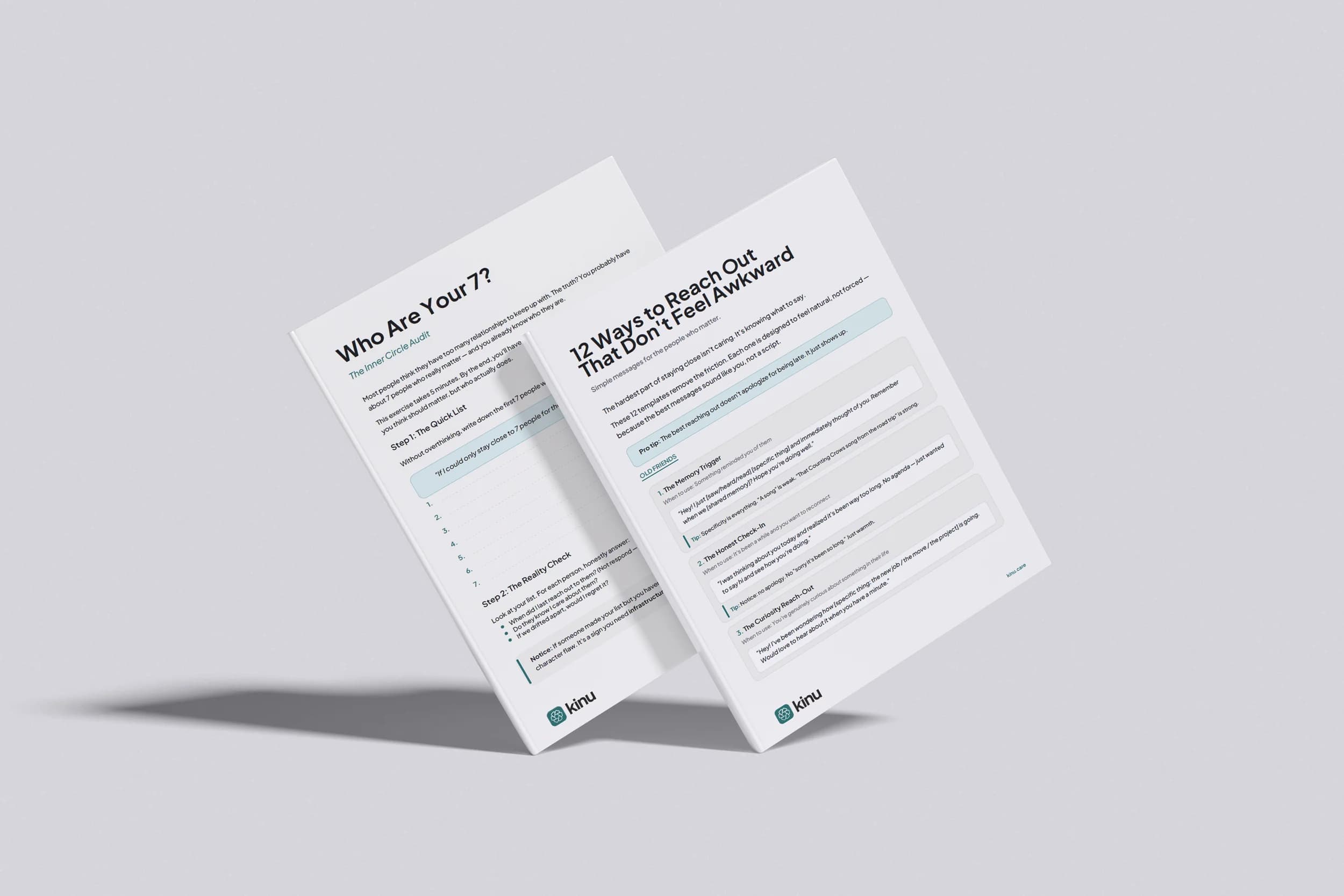
A 5-minute exercise to find your inner circle and 12 reach-out templates that sound like you. Free, instant download.
Instant download. No spam. Unsubscribe anytime.
Keep reading
Personal CRM for Friends and Family: The Lists Are Written by the Apps
Every roundup in this category is published by one of the apps in it, this one included. Here is the map, ordered by a rule you can check, with every price read from the product's own page.
The Personal CRM Graveyard: Which Apps Shut Down, and Which Only Look Dead
UpHabit shut down its apps in April 2026. We checked eleven personal CRM apps, including our own, against primary sources, and two of the three shutdown claims we tested turned out to be wrong, including one of ours.
Notion Personal CRM vs 23 Dedicated Apps
Building a Notion personal CRM? See what the template does well, where it hits a wall, and 23 dedicated apps built to remember the people you care about.