Fabriq Alternatives in 2026: Four Apps Compared
Five alternatives to Fabriq for staying close to friends and family. Current pricing and platforms, checked by hand, and who should switch and who should stay.
Fabriq shipped iOS 2.4.6 on 2 June 2026, so it is under active development. People still look for alternatives for reasons that have not changed: the 150-person cap, no desktop app, and a team that communicates rarely enough that a directory once listed the app as discontinued. If one of those is your reason, the comparison below is for you.
The short answer: if you came to Fabriq for gentle, private check-ins with the people who matter and you want faster movement, Kinu is the closest match in spirit. A private place for the little things about your people. Native iOS and Android. Local-first. Encrypted sync between your devices on Plus. Free for up to 10 people.
Disclosure: Kinu is our product.
Fabriq vs Kinu at a Glance
| Fabriq | Kinu | |
|---|---|---|
| Last verified update | iOS v2.4.6 on 2 Jun 2026; Play v2.4.5 on 20 Jul 2026 | Active, monthly releases |
| Development status | Shipping again after a long public silence; no public roadmap | In active development with a public changelog |
| People cap | 150 contacts | 10 free, unlimited on Plus |
| Platforms | iOS, Android (mobile only) | iOS, Android, Web |
| Data location | On device, no encrypted sync | Local-first, encrypted sync |
| Price | Free / $4.99 a month / $39.99 a year | Free up to 10 people, $69.99/yr unlimited |
| Team communication | Rare; stale site, no roadmap | Public changelog and roadmap |
| Best for | A small circle, phone-first, comfortable with a quiet team | Calm, private, personal use |
If you like Fabriq's vibe, you will recognize most of Kinu. It is the same intent, with more room and more signal about where it is going.
Why Fabriq Users Are Looking for Alternatives
Fabriq has a good idea and a real audience. The reasons people consider leaving are mostly structural, and the recent updates change only one of them.
Long public silences
The iOS app sat on version 2.4.1 from November 2023 until June 2026. It is shipping again, and that is genuinely good news, but a two-and-a-half-year gap with no word from the team is a pattern you have to decide whether to trust with years of notes about your people.
A hard 150-person cap
Fabriq tops out at 150 contacts. For some people that is fine. For anyone with a large extended family, a coaching practice, or just a lot of long-running friendships, it becomes a wall.
No desktop, ever
Fabriq lives entirely on your phone. There has never been a desktop or web version for longer reflection, journaling about a relationship, or looking at patterns over time.
Communication you have to go digging for
No public roadmap, a stale website, and updates that arrive unannounced. It was quiet enough that a directory listed Fabriq as discontinued while it was actively shipping. The product moves; the team just does not say so.
Fabriq deserves its due: it saw earlier than almost anyone that relationships need a calm home, and its core loop still reflects that. The open question is cadence and communication, not intent. That is worth weighing before you move your data, in either direction.
How Kinu Compares to Fabriq
Kinu started from the same belief as Fabriq. Your people deserve a quiet, private place that is not your inbox or your camera roll. The execution is different in three specific ways.
1. A steady, visible cadence
Kinu ships monthly and says so in a public changelog. Bugs get fixed and the fixes are announced. That matters because the whole point of a relationship app is durability: you are trusting it with years of context about people you love, and you deserve to see the heartbeat rather than infer it from a version number. If you want the longer version, see why we built Kinu and the philosophy of calm technology behind it.
2. Local-first with real encrypted sync
Your data lives on your device by default, the same way it does in Fabriq. The difference is what happens when you want a second device or a backup. Kinu encrypts everything on your device before it leaves your phone. The server only ever sees opaque blobs, and we do not access your relationship content (how the encryption works). You get the privacy story Fabriq users assumed they had, with the multi-device option Fabriq never built.
3. Warmth instead of a counter
Fabriq centers the reminder; Kinu centers the person. The difference shows up all over both products.
Where Fabriq gives you a contact and a frequency, Kinu gives you the Relational Compass: the same people, arranged by how close you actually are, with an intention and an energy mode per person instead of a timer. No streaks, and no guilt counter ticking up beside anyone's name.
Other Fabriq concepts that map to Kinu:
| Fabriq concept | Kinu equivalent |
|---|---|
| Contact | Person |
| Check-in frequency | Closeness + Mode (active, low energy, paused) |
| Reminder | Important date plus opt-in nudge |
| Notes on a contact | Moments (light observations) plus Private Notes (never processed) |
| Groups | Lenses (Family, Friends, Work, custom) |
The two apps share more vocabulary with each other than either shares with a sales CRM, which makes this the least jarring switch on this page.
How to Migrate from Fabriq, If You Decide To
No urgency theater here: Fabriq works today and is shipping updates. The migration question is about the cap, the missing desktop, and how much silence you are comfortable with. If you do decide to move, this is the clean way.
Screenshot your list first
Before anything else, open Fabriq and screenshot your full people list and any frequency settings. There is no formal export, so screenshots are your record of what to carry over.
Start with your inner circle
Do not try to move every contact. Kinu is for the people who matter, not your full address book. Start with the people you would miss first; the free tier covers ten.
Re-enter, do not re-import
Re-entering someone is faster than it sounds, and slower in exactly the right way: choosing what to write about each person is half the value of writing it. You will keep more of it than an import would have given you.
Park the long tail in paused mode
For people you want to keep around without active maintenance, set their mode to "paused" and drop any context in their Private Note. Kinu will not nudge you. They are still there when you want them.
Where Each App Wins
This is not a clean upgrade in every direction.
Where Fabriq is better than Kinu
- A bigger circle, by design. Fabriq is built around 150 relationships, filled as Dunbar circles: five inner, ten middle, thirty-five outer, a hundred extended. Kinu is free for ten people and $69.99 a year for unlimited, so if you want to hold a hundred and fifty, Fabriq is shaped for it and Kinu is not.
- Simpler mental model on day one. Fabriq has fewer concepts. You pick a frequency and wait for a nudge. Kinu has Lenses, Moments, Modes, and a Relational Compass. That richness is the point, but it is more to learn.
- One-tap input. Fabriq's check-in flow is very fast. Kinu's flow is fast too, but Fabriq deserves credit for the original pattern.
Where Kinu is clearly better
- You can see it being maintained. Kinu ships monthly with a public changelog too. Fabriq ships too, but on a cadence and communication pattern you have to take on faith.
- Encrypted sync across devices. Fabriq never had this. Kinu has it on Plus, and the server only ever stores ciphertext.
- Sync between devices. Available on Kinu Plus, so a longer note written on the web is on your phone too. Fabriq is mobile only, and always has been.
- No 150-person ceiling. Plus is unlimited. If your "people who matter" list grew past Fabriq's cap, this alone is worth the move.
- A calmer model. Modes for different life seasons. No streaks. No urgency. Private Notes that the system never processes.
- Free tier that actually works. 10 people, all features, indefinitely. Most Fabriq users fit inside that on their inner circle alone.
Other Active Alternatives Worth Knowing
If Kinu is not the fit, here are the credible options that are still being built in 2026. We covered these in depth in our personal CRM vs relationship apps guide.
Monica
Monica is the open-source personal CRM. Strong on privacy and ownership if you are willing to self-host. The hosted plan removes the setup pain but keeps the web-only experience, which is a downgrade if you came to Fabriq for the phone-first feel.
People who want maximum data ownership and are comfortable with web or self-hosting.
No native mobile app. Self-hosting is a real commitment.
Clay (now Mesh)
Clay was acquired by Automattic in 2025 and rebranded Mesh. AI builds rich profiles from your email, calendar, and social accounts. Excellent for professional networking. The privacy trade-off is real: Clay needs broad access to your data to work, which is the opposite of what most Fabriq users wanted.
Professionals with large networks who want automation.
No Android. AI features feel invasive for purely personal use.
Dex
Dex is the fullest-featured of the hosted options: it pulls from LinkedIn and your inbox, enriches contacts automatically, and suggests conversation openers. Solid and actively built. The vocabulary stays CRM-heavy, which can feel cold if Fabriq's warmth is what you like.
People who want structure and integrations and do not mind the CRM framing.
No free tier. $12 a month billed annually, $20 monthly. Professional tone throughout.
Should You Stay with Fabriq?
As of this rewrite: maybe. If your circle fits under 150 people, your whole life is on your phone, and the app is doing its job for you, the June and July 2026 updates are a real reason to relax. Staying is a defensible choice.
The reasons to move are the structural ones that updates do not change:
- The 150-person cap, if you are anywhere near it.
- No desktop and no encrypted multi-device sync, if you want your notes on more than one screen.
- The communication pattern. A team that goes years without a public word can do it again. Whatever you decide, screenshot your list occasionally; there is still no formal export, and that advice is good for any app that holds things you would mind losing.
If you want a broader view of the active landscape, our best apps to stay in touch guide compares the leading options head to head.
One Question to Decide
If you loved Fabriq because it felt calm and private, choose Kinu. If you want more structure and integrations and do not mind paying for it, choose Dex. If you want self-hosted ownership and live in a browser, choose Monica.
Try Kinu Free
If Fabriq's vision resonated and you want the same calm with more room and a visible heartbeat, Kinu is free for up to 10 people on iOS and Android. No credit card. No 150-person cap waiting for you. You add the people who matter. Kinu helps you keep the little things about them and brings them back when they matter. It is the idea Fabriq pioneered, with more room around it.
For the underlying ideas, see our pieces on how to maintain friendships as an adult and the difference between a personal CRM and a relationship app.
Frequently Asked Questions
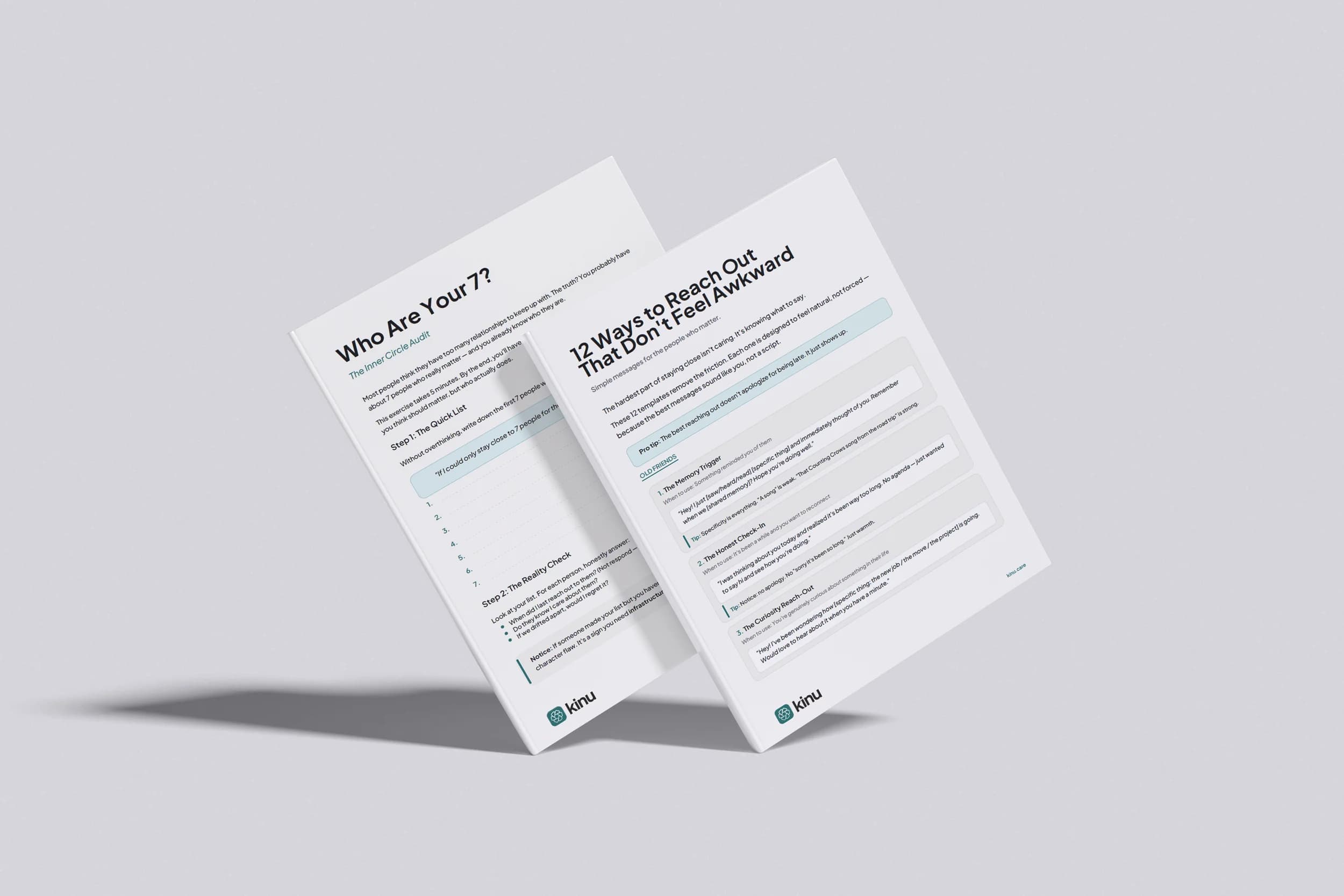
Free Reconnection Kit
Find your inner circle in five minutes.
A 5-minute exercise to find your inner circle and 12 reach-out templates that sound like you. Free, instant download.
Instant download. No spam. Unsubscribe anytime.
Keep reading
Personal CRM for Friends and Family: The Lists Are Written by the Apps
Every roundup in this category is published by one of the apps in it, this one included. Here is the map, ordered by a rule you can check, with every price read from the product's own page.

The Personal CRM Graveyard: Which Apps Shut Down, and Which Only Look Dead
UpHabit shut down its apps in April 2026. We checked eleven personal CRM apps, including our own, against primary sources, and two of the three shutdown claims we tested turned out to be wrong, including one of ours.
Notion Personal CRM vs 23 Dedicated Apps
Building a Notion personal CRM? See what the template does well, where it hits a wall, and 23 dedicated apps built to remember the people you care about.